Congress Should Demand Evidence on Drug Patents, Not Metaphors
By Mark Schultz and Jennifer Bran, op-ed.
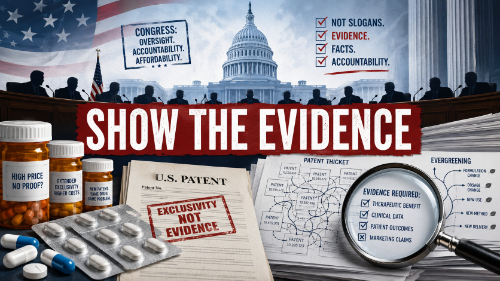
Lawmakers recently held a hearing on how to balance pharmaceutical innovation and patient access. Predictably, the discussion returned to two familiar themes: so-called patent "thickets" and "evergreening." Critics argue that drug companies use both to delay generic competition, extend exclusivity, and keep prices high.
The evidence tells a different story: generic competition routinely arrives years before all patents associated with a medicine expire, and more than 90% of U.S. prescriptions are filled with generics. The system is working as intended.
Patent rules for medicines should be based on evidence, not metaphors.
Advocacy groups claim that every patent associated with a drug prevents generic entry. They allege that companies file patents on trivial modifications to create "thickets" around new drugs. They count all patents connected to a medicine, identify the latest-expiring patents, and imply that generics are blocked until then.
What most people view as a drug is actually a bundle of inventions. Transforming a promising molecule into a drug that can be administered to patients and secure regulatory approval requires that scientists solve a range of problems. Each solution may represent a patentable invention.
That process explains why multiple patents are filed on a medicine over time. Later patents protect new formulations, delivery systems, and uses developed during and after development. They cover improvements -- not the original medicine itself.
Critics often treat later-filed patents as extensions of earlier ones. They are not. Patents have fixed 20-year terms. What critics call "evergreening" is often the process of improving a medicine for patients.
Research does not support claims that patent thickets or evergreening delay generic competition.
The average time from a brand drug's launch to its first generic patent challenge has fallen from nearly 19 years in the mid-1990s to about 6 years today. More than 80% of new drugs now face patent challenges.
One study of 130 bestselling drugs found no relationship between patent counts and effective patent life. The authors concluded that patent thickets, if they exist, "appear to be rather easy to circumvent."
Generics enter the market on a predictable schedule -- roughly 13 to 14 years after launch. That timing has remained stable for decades.
An audit of more than 200 entries in the UCSF Evergreen Drug Patent Database found that generic competition arrived, on average, seven years before the database predicted.
The UCSF database's claims about aspirin -- generic for more than a century -- illustrate the problem. The database says aspirin's patent protection was extended until 2032. In reality, the later patents covered a new liquid-filled capsule designed to dissolve in the small intestine, not ordinary aspirin. Aspirin's exclusivity was not extended.
The claim that biopharma companies receive excessive patents also fails under scrutiny. A USPTO study found that large patent families are far less common in biopharma (1.3%) than in computer networks and semiconductors (55.5%). Biopharma companies also receive fewer patents per R&D dollar than other innovators.
Changes to patent law should be based on market evidence. Restricting patents on drug improvements may not lower prices, but it would reduce incentives to develop patient-friendly treatments.
Congress deserves evidence, not slogans. Patients do too.
Mark Schultz is the Faculty Chair of the IP Policy Institute, The University of Akron. Jennifer Brant is Senior Advisor at Sidley and Practitioner in Residence at the IP Policy Institute. Their new research on patent thickets and evergreening can be found at https://www.unpackingip.org/ipandbiopharma
Editor’s note: This guest commentary reflects the authors’ views on pharmaceutical patent policy. The issue remains debated among legal, health care and competition-policy experts, with some researchers arguing that patent thickets and evergreening can delay lower-cost generic or biosimilar competition in certain cases.
 News Staff
 -
-
Health
pharmaceutical innovation
generics prescriptions
-
503 views -
0 Comments -
0 Likes -
0 Reviews
-
-
Health
pharmaceutical innovation
generics prescriptions
-
503 views -
0 Comments -
0 Likes -
0 Reviews