Seeds Against Disaster
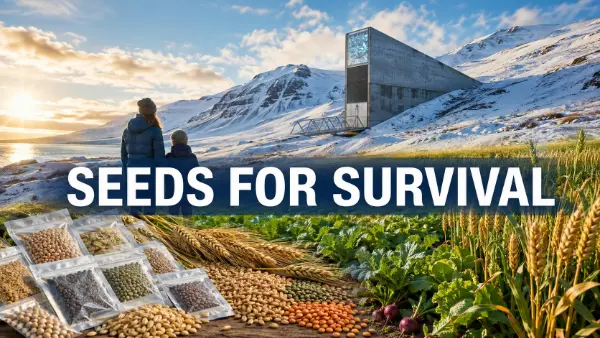
Deep inside an Arctic mountain, nearly halfway between mainland Norway and the North Pole, humanity keeps a frozen insurance policy for the future of food.
The Svalbard Global Seed Vault stores duplicate samples of seeds collected by gene banks around the world. The seeds represent thousands of varieties of wheat, rice, barley, corn, chickpeas, lentils and other crops—including older varieties that may contain valuable resistance to drought, disease, heat or flooding.
Opened in 2008 on the Norwegian island of Spitsbergen, the vault’s storage chambers sit more than 100 meters inside solid rock, beneath another 40 to 60 meters of mountain. Its three halls have room for approximately 4.5 million seed samples.
In June 2026, the vault announced that its collection had crossed the 1.4 million mark following a deposit of more than 15,000 samples from 11 gene banks. Its inventory includes more than 6,500 species from over 130 depositors. The number can fluctuate when depositing institutions retrieve their own material.
Often nicknamed the “Doomsday Vault,” Svalbard is not intended to supply farmers directly after an apocalypse. It functions more like a safety-deposit box for the world’s working gene banks. Depositing institutions retain ownership, and only they may request the return of their seeds.
The storage rooms are mechanically cooled to minus 18 degrees Celsius, or about zero degrees Fahrenheit. Backup generators are available if outside electricity is interrupted. The surrounding permafrost would keep the seeds frozen for an extended period without mechanical cooling, although it would not maintain the ideal storage temperature indefinitely.
Norway also waterproofed and upgraded the entrance tunnel and cooling system between 2016 and 2019 to prepare the facility for a warmer, wetter Arctic climate.
The vault’s value became unmistakably clear during Syria’s civil war.
The International Center for Agricultural Research in the Dry Areas, known as ICARDA, maintained an important gene bank at Tel Hadia, outside Aleppo. Its collection included ancient and locally adapted varieties of durum wheat, barley, chickpeas, lentils and fava beans from the Fertile Crescent.
As fighting intensified, most ICARDA personnel left Syria, and the collection became increasingly difficult to access and maintain. Fortunately, the organization had already sent duplicate samples to Svalbard.
In 2015, ICARDA requested approximately 38,000 samples—the first withdrawal in the vault’s history. The seeds were not returned to Aleppo. Instead, they were shipped to new research facilities in Lebanon and Morocco, where scientists planted them, harvested fresh seeds and began reconstructing the collection.
The project eventually recovered nearly all the original holdings. Of 141,052 samples maintained before the war, all but 1,657 were successfully backed up. Regenerated duplicates were later returned to Svalbard in 2017 and 2019.
The Syrian experience corrected one important misconception: Svalbard is not merely a monument built for an imaginary end-of-the-world scenario. It is a functioning global backup system—and it has already helped rescue an irreplaceable part of humanity’s agricultural heritage.
 Max Liebermann
 -
-
Health
Norway
The Svalbard Global Seed Vault
gene bank
Doomsday Vault
-
352 views -
0 Comments -
0 Likes -
0 Reviews
-
-
Health
Norway
The Svalbard Global Seed Vault
gene bank
Doomsday Vault
-
352 views -
0 Comments -
0 Likes -
0 Reviews





 Loading ...


