How the Bayh-Dole Act Helped Transform Prostate Cancer Detection and Why It Must Be Protected
Guest Commentary, op/ed by Dr. Robert Dannals
About one in eight American men will be diagnosed with prostate cancer during their lifetime. It is the second-deadliest cancer for American men, claiming tens of thousands of lives every year.
Today, however, physicians have a powerful tool that allows them to detect prostate cancer accurately and determine how far it has spread before treatment begins. Since receiving FDA approval in 2021, the PET radiotracer that my former Johns Hopkins University colleague, Dr. Martin Pomper, and I helped develop has been used in more than 760,000 patients and will help many more.
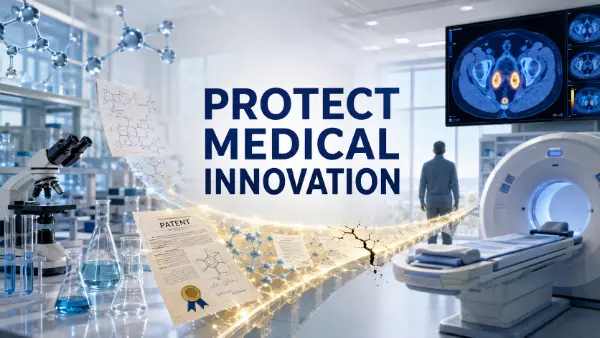
Yet bringing the test to patients was far from simple. Its journey from university laboratory to hospital imaging suite was made possible by one of the most successful, and least appreciated, pieces of innovation policy in American history: the Bayh-Dole Act of 1980. This Act allows universities, federal laboratories, and small businesses to patent federally-funded discoveries and license them to private companies for commercialization.
As policymakers debate the future of federally-funded research, they must remember what Bayh-Dole has accomplished. Without it, countless discoveries would never leave university laboratories, patients would lose access to lifesaving innovations, and taxpayers would see far less return on their investment in scientific research.
I have spent much of my career translating laboratory discoveries into diagnostic and therapeutic tools that physicians can use to improve patient care. So, when Dr. Pomper's team created a promising molecule that selectively targeted and lit up prostate cancer cells in PET scans, my team wanted to help develop it into a practical tool for diagnostic nuclear medicine.
But there was still a long way to go before the breakthrough could benefit patients. The technology required years of costly clinical trials, regulatory review, and FDA approval. No academic laboratory could handle that burden alone. It required a private-sector partner willing to invest substantial time, expertise, and capital in the face of significant financial risk.
That was where the technology transfer system established by Bayh-Dole made all the difference.
Bayh-Dole allowed Johns Hopkins to patent our compound and its synthesis and license it to Progenics Pharmaceuticals. Progenics saw our discovery's potential and invested its resources and expertise to conduct clinical testing and develop the compound into an FDA-approved product.
This is why policymakers must protect Bayh-Dole, the broader technology transfer system it anchors, and the federal research funding that allows institutions like Johns Hopkins to pursue early-stage discoveries in the first place.
Recently, critics have questioned whether this system delivers enough return on public investment. Some have proposed reducing research funding or reinterpreting Bayh-Dole to give the government greater control over university inventions. While perhaps well-intentioned, they risk undermining the very system that has enabled many scientific breakthroughs to become real-world medical advances.
America's universities excel at generating new knowledge. America's private sector excels at transforming that knowledge into products that physicians prescribe and patients rely on. Bayh-Dole provides the bridge between those two worlds.
If we want federally-funded research to continue delivering lifesaving discoveries, and not just scientific publications, we should strengthen, not weaken, the Bayh-Dole Act.
Dr. Robert Dannals is a professor in the Johns Hopkins Medicine Department of Radiology and Radiological Science.
Editor’s note: Robert F. Dannals, Ph.D., is a Johns Hopkins professor and a named inventor on university-held patents related to the synthesis of the imaging agent discussed in this commentary. He and Martin Pomper received a 2026 American Innovator Award from the Bayh-Dole Coalition. This article expresses the author’s views and is presented as commentary, not independent news reporting.
 News Staff
 -
-
Health
Medical
Prostate Cancer Detection
Dr. Robert Dannals
Dr. Martin Pomper
-
474 views -
0 Comments -
0 Likes -
0 Reviews
-
-
Health
Medical
Prostate Cancer Detection
Dr. Robert Dannals
Dr. Martin Pomper
-
474 views -
0 Comments -
0 Likes -
0 Reviews





 Loading ...


