Americans Fall Behind
Americans are carrying record levels of household debt — and a growing number are now falling seriously behind on the two payments that can matter most: their homes and their cars.
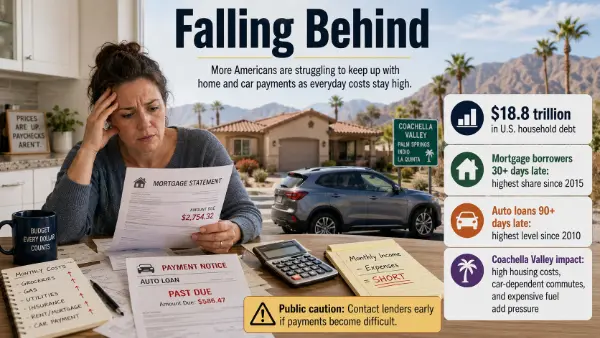
New Federal Reserve Bank of New York data show that U.S. household debt stood at roughly $18.8 trillion in the second quarter of 2026, with signs of mounting financial stress among borrowers already squeezed by housing costs, expensive vehicles, gasoline, food, insurance and other necessities.
The warning signs are particularly clear in mortgages and auto loans.
The share of borrowers moving at least 30 days behind on mortgage payments reached its highest quarterly level since 2015. At the same time, serious auto-loan delinquency — generally defined as payments at least 90 days overdue — climbed to its highest level since around 2010.
The numbers do not suggest that the United States is entering another 2008-style financial crisis. Most Americans are still paying their debts on time, and approximately 4.7% of outstanding household debt was in some stage of delinquency during the quarter.
But averages can hide trouble.
For households living paycheck to paycheck, the margin between staying current and missing a payment can be remarkably small.
One car repair. One medical bill. Fewer work hours. A jump in insurance. Higher grocery bills. Another month of expensive gasoline.
That can be enough.
The result is an economy increasingly divided between households with secure jobs, investments and significant home equity and those whose monthly income is largely consumed before the next paycheck arrives.
Auto debt flashes a warning
Americans borrowed a record $211 billion for automobiles during the second quarter, although that figure is not adjusted for inflation.
Total outstanding auto-loan balances increased by about $28 billion to $1.71 trillion.
Those numbers deserve attention because a car is not a discretionary expense for much of the country.
For millions of workers, a vehicle is what makes employment possible. It gets them to work, school, medical appointments, grocery stores and other essential services.
Once an auto loan falls seriously behind, borrowers can face repossession — and losing transportation can quickly make an already difficult financial situation worse.
Fuel costs are adding pressure.
In Riverside County, regular gasoline is currently averaging about $5.60 per gallon, compared with approximately $4.31 a year ago. Diesel prices are approaching $7 per gallon.
For a family operating two vehicles, that increase alone can absorb a significant portion of the household budget.
And fuel is only one part of transportation costs. Auto insurance, repairs, registration, tires and monthly financing payments have all become substantial expenses.
A household paying $700 or $800 a month for a vehicle can quickly become vulnerable when several of those costs rise at the same time.
Credit-card balances keep growing
Credit-card balances increased another $21 billion during the quarter to approximately $1.26 trillion.
Home-equity line-of-credit balances reached roughly $459 billion, while student-loan balances stood near $1.65 trillion.
Reported mortgage balances declined by approximately $74 billion to around $13.1 trillion, but Federal Reserve researchers cautioned against interpreting that as a major reduction in housing debt.
The decline was largely the result of a temporary credit-reporting gap created when mortgages were transferred between servicing companies.
Without that technical issue, total household debt would have increased during the quarter.
Why the Coachella Valley should pay attention
The national numbers have particular relevance in the Coachella Valley and greater Palm Springs area.
Palm Springs, Palm Desert, Cathedral City, Rancho Mirage, Desert Hot Springs, Indio, La Quinta and Coachella are heavily dependent on automobiles.
Public transportation is available, but the Valley’s geography and widely dispersed employment centers mean that many residents have little practical choice but to drive.
That makes rising fuel prices especially painful.
A jump of more than a dollar per gallon can translate into hundreds of dollars in additional annual expenses for a commuter — and considerably more for families with multiple vehicles or long daily drives.
The broader Riverside-San Bernardino-Ontario labor market also remains somewhat softer than the national economy, with unemployment recently around 4.6% and total nonfarm employment near 1.72 million jobs.
The desert economy adds another layer of vulnerability because it relies heavily on hospitality, restaurants, tourism, retail, construction and other industries where hours and income can fluctuate with the season.
A worker whose schedule is reduced for several weeks may still have exactly the same mortgage payment, car loan, insurance bill and credit-card minimum due.
That is where financial stress can begin to compound.
Not a crisis — but a caution
The Federal Reserve data should not be interpreted as evidence that the U.S. financial system is on the verge of collapse.
Consumer spending remains resilient. Unemployment remains relatively low by historical standards. Many homeowners have substantial equity, and millions of households continue to meet their financial obligations comfortably.
But rising delinquency among more vulnerable borrowers is a warning signal.
People generally do not stop paying their mortgage or car loan casually. By the time a borrower becomes 60 or 90 days delinquent, other financial options may already have been exhausted.
Consumers who see trouble developing should contact lenders early rather than waiting until several payments have been missed.
Mortgage servicers and automobile lenders may offer hardship assistance, temporary payment arrangements or other options depending on the borrower’s circumstances.
Consumers should also be cautious about using expensive credit cards, payday loans or other high-cost debt merely to keep another loan current.
And anyone facing financial distress should be wary of companies promising guaranteed foreclosure prevention, instant debt elimination or loan modifications in exchange for large upfront fees.
The latest numbers do not say America is reliving 2008.
They do say that for millions of Americans, there is less room for another financial surprise.
And in the Coachella Valley, where driving is essential, housing costs remain substantial and many jobs depend on seasonal industries, that warning hits particularly close to home.
 Max Liebermann
 -
-
Business
Federal Reserve Bank of New York
U.S. household debt stood at roughly $18.8 trillion in the second quarter of 2026
-
99 views -
0 Comments -
0 Likes -
0 Reviews
-
-
Business
Federal Reserve Bank of New York
U.S. household debt stood at roughly $18.8 trillion in the second quarter of 2026
-
99 views -
0 Comments -
0 Likes -
0 Reviews