Wall Street Wins, Main Street Waits
Wall Street threw itself a record-setting party Tuesday. Unfortunately, the invitation did not include a grocery coupon, a smaller mortgage payment or assistance with next month’s health insurance premium.
The S&P 500 climbed 1.8% to a record closing level of 7,736.52, its first closing high since July 2. The Dow Jones Industrial Average gained more than 900 points to finish at 54,085.88, also a record. The technology-heavy Nasdaq Composite jumped 2.6% to 26,584.99, although it remained below its previous peak.
It was a powerful rally—but not proof that every American household suddenly became wealthier.
The stock market measures what investors believe large corporations are worth and what those companies may earn in the future. It does not measure whether a family can afford rent, whether a senior can pay for prescriptions, or whether a first-time buyer can qualify for a mortgage.
In other words, the Dow can rise 900 points while somebody is standing in a supermarket aisle wondering whether the eggs are now a luxury item.
Several developments drove Tuesday’s surge. Corporate earnings have been stronger than expected, technology stocks are recovering from their summer decline, and investors remain enthusiastic—sometimes breathtakingly enthusiastic—about artificial intelligence.
Palantir shares soared nearly 30% after the technology company raised its revenue forecast. Caterpillar gained almost 6% after reporting stronger profits and increasing its annual sales outlook. The construction of enormous AI data centers is creating demand for Caterpillar’s power-generation systems and heavy equipment.
Apparently, even the digital future needs bulldozers.
Investors also welcomed signs that diplomatic negotiations could lead to the reopening of the Strait of Hormuz, one of the world’s most important oil-shipping routes. Treasury Secretary Scott Bessent said an agreement with Iran could be reached within days, although the outcome remained uncertain.
Oil prices fell about 5% on that optimism, helping calm fears that higher fuel and transportation costs would worsen inflation. Treasury yields also declined, and traders reduced their expectations for another Federal Reserve interest-rate increase.
Strong profits, falling oil prices and lower bond yields are almost the Wall Street version of having dessert delivered before anyone asks for the check.
Corporate America has provided investors with legitimate reasons for optimism. By July 31, 61% of S&P 500 companies had released second-quarter results, and 86% reported profits exceeding analysts’ expectations. Overall earnings growth was running at its strongest pace in five years.
However, the numbers require some perspective. Unusually large gains reported by Alphabet and Amazon substantially boosted the combined results. Even without those companies, earnings growth remained strong—but the headline figure was not quite as magical as it first appeared.
The market is also heavily influenced by a relatively small group of enormous corporations. Because the S&P 500 gives greater weight to companies with larger market values, a sharp increase in a few technology giants can lift the entire index. Five hundred companies may be included, but they do not each receive an equal vote.
That helps explain how the market can reach a record even when many Americans do not feel remotely prosperous.
For households, Tuesday’s rally could eventually provide some benefits. Lower oil prices, if sustained, could bring relief at gasoline stations and reduce shipping and transportation costs. Those savings might gradually work their way into the prices of food and other products.
Falling Treasury yields could also help reduce mortgage rates, auto-loan costs and other borrowing expenses. But one good day in the bond market will not suddenly turn an unaffordable house into an affordable one. Mortgage rates respond to longer-term economic expectations, inflation and credit conditions—not merely to Wall Street’s mood on a Tuesday afternoon.
People with 401(k) plans, individual retirement accounts, college funds or public pensions may see their account balances rise. Pension systems invested in the market could also become financially stronger, helping teachers, firefighters, government employees and retirees.
That is the good news.
The less cheerful news is that Americans do not share equally in stock-market gains. The wealthiest 1% of households owned 50.2% of corporate stocks and mutual-fund shares during the first quarter of 2026. The richest 10% owned approximately 87%.
Therefore, when the market creates billions of dollars in new paper wealth, most of it flows to people who already possess the largest portfolios. A wealthy investor can gain enough in one afternoon to purchase another house. A restaurant employee may gain a few dollars in a retirement account—assuming that worker has one—while still facing a $200 rent increase.
So, is this the familiar story of the rich getting richer while the poor get the shaft?
The honest answer is: largely, but not entirely
A healthy stock market can support investment, business expansion, retirement savings and employment. Companies whose shares rise may find it easier to raise money, construct facilities or hire workers. Consumer confidence can also improve when retirement accounts grow.
But those benefits are indirect, uneven and often slow to reach people living paycheck to paycheck. The immediate rewards go primarily to shareholders, corporate executives whose compensation includes stock, large investment funds and wealthy households.
Meanwhile, the latest government figures showed consumer prices remained 3.5% higher than a year earlier. Grocery prices were up 2.7%, shelter costs rose 3.3% and medical-care services increased 2.9%.
Those percentages may appear manageable on an economist’s chart. They feel considerably larger when added to rent, insurance premiums, prescription costs and a cart of groceries.
Even falling inflation does not usually mean prices are falling. It means prices are increasing more slowly. If a $100 grocery bill rises to $110 and then stops climbing as quickly, it is still $110. The cashier does not congratulate customers on the improved rate of inflation.
Health care provides another important example. Pharmaceutical and insurance company shares may rise because investors expect higher profits. That can benefit shareholders and retirement accounts, but it does not automatically lower premiums, deductibles or prescription prices. A profitable health-care sector and affordable health care are not necessarily the same thing.
The same is true of housing. Rising bank and construction stocks may signal confidence in the economy, but they do not create enough affordable homes or provide a down payment to a working family. In places such as the Coachella Valley, where housing, utilities and summer energy bills can place substantial pressure on household budgets, record stock prices may feel like news from a different financial universe.
There are also reasons for caution. The market’s optimism partly depends on continuing AI profits and progress toward reopening the Strait of Hormuz. A setback in either area could quickly reverse some gains. August through October has historically been the S&P 500’s weakest three-month period, and concentrated enthusiasm around one investment theme can produce painful swings.
Tuesday was unquestionably excellent news for investors and American corporations. It may eventually help the broader economy through lower energy costs, improved retirement balances and cheaper borrowing.
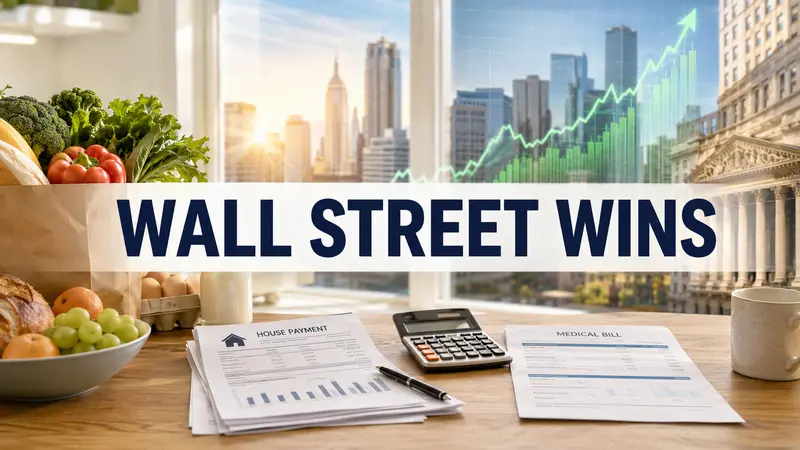
But a record stock market should not be confused with universal prosperity. Wall Street’s scoreboard is flashing bright green. At America’s kitchen tables, families are still opening the bills.
For the wealthy, the market rally added another generous serving. For millions of ordinary Americans, the promise remains that some crumbs may eventually reach the table—after Wall Street finishes dessert.
 News Staff
 -
-
Business
The S&P 500 climbed 1.8%
Nasdaq Composite jumped 2.6% to 26
584.99
Dow Jones 900points
-
59 views -
0 Comments -
0 Likes -
0 Reviews
-
-
Business
The S&P 500 climbed 1.8%
Nasdaq Composite jumped 2.6% to 26
584.99
Dow Jones 900points
-
59 views -
0 Comments -
0 Likes -
0 Reviews