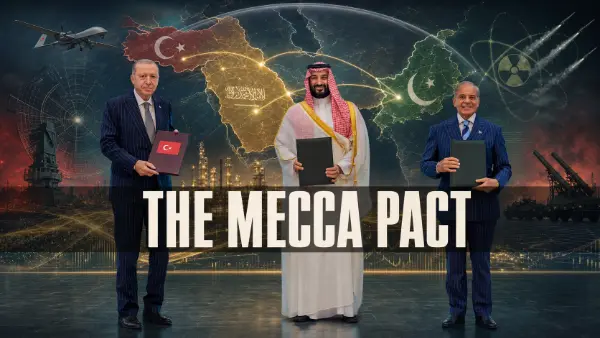
The Mecca Pact
Saudi Arabia, Turkey and Pakistan have created a new mutual-defense partnership in one of the world’s most dangerous regions. It is a significant development—but not quite the ready-made “Islamic NATO with nuclear weapons” described in some headlines.
The Mecca Joint Defense Agreement was signed on August 7, 2026, by Saudi Crown Prince Mohammed bin Salman, Turkish President Recep Tayyip Erdoğan and Pakistani Prime Minister Shehbaz Sharif. Contrary to one widely circulated caption, the Pakistani participant was not President Asif Ali Zardari.
The agreement declares that an armed attack against any of the three states will be considered an attack against them all. It also promises wider defense cooperation and collective deterrence.
That is unmistakably a mutual-defense commitment. But describing it as the equivalent of NATO goes too far. NATO has permanent institutions, an integrated military structure and decades of joint planning. The publicly released language of the Mecca agreement does not explain what assistance must be provided, who determines whether an attack has occurred or how the three armed forces would operate together.
Even NATO’s famous Article 5 does not automatically require every member to declare war or provide an identical response. Nor would an attack on Saudi Arabia or Pakistan automatically pull the rest of NATO into the conflict simply because Turkey is a member.
The nuclear question
Pakistan is the only one of the three countries with nuclear weapons. That gives the agreement an unavoidable nuclear shadow—but not a confirmed nuclear umbrella.
Nothing in the publicly disclosed text says that Pakistan would use nuclear weapons to defend Saudi Arabia or Turkey, station warheads abroad or share control of its arsenal. Saudi Arabia has specifically stated that the agreement is not connected to nuclear ambitions or an arms race.
The careful conclusion is that Pakistan’s arsenal strengthens the pact’s political deterrent effect. Claims of an operational Pakistani nuclear shield over Saudi Arabia or Turkey, however, remain unproven.
What each country brings
The three partners possess complementary strengths.
Pakistan contributes a large and experienced military, nuclear deterrence and a long history of security cooperation with Saudi Arabia. Pakistani forces have previously been deployed to the kingdom for training, coordination and defense.
Turkey brings NATO experience and a rapidly expanding defense industry. Saudi Arabia has purchased Turkish combat drones, while Saudi and Turkish companies have agreed to localize parts of drone production in the kingdom.
Saudi Arabia supplies capital, energy influence and strategic geography. In 2025, its estimated military expenditure reached approximately $83.2 billion, representing about 6.5 percent of its economy. It also has an urgent security problem: missiles and relatively inexpensive drones have repeatedly threatened Gulf infrastructure. Such weapons can be difficult and costly to defeat with traditional missile interceptors that may cost far more than the drones they destroy.
Joint air defense, intelligence coordination, weapons development and technology transfer would therefore make strategic sense. Nevertheless, these should be described as likely areas of cooperation—not confirmed treaty provisions until more of the agreement is released.
Iran, Israel—or neither?
The timing makes Iran impossible to ignore. Iranian attacks have affected Saudi Arabia, other Gulf states and Turkey, while Tehran’s regional networks and pressure on shipping have intensified the search for stronger deterrence.
Still, all three signatories have reasons to avoid presenting the agreement as an anti-Iran coalition. Pakistan has acted as a mediator with Tehran. Turkey maintains economic and diplomatic ties with Iran. Saudi Arabia, despite coming under attack, has supported negotiations intended to prevent a larger regional war.
Israel is another factor, particularly because Turkish-Israeli relations have deteriorated over Gaza and other regional conflicts. Yet there is no evidence in the released agreement that Israel is its designated opponent. The pact also does not formally prevent a future normalization of relations between Saudi Arabia and Israel.
The agreement is best understood as strategic insurance. Its members do not fully trust the existing regional order—or the reliability of outside protection—so they are building an additional layer of security for themselves.
Will it create stability?
Possibly, but deterrence has two faces.
If potential attackers believe that aggression against one country will produce a coordinated response from three, the agreement could discourage attacks. Shared radar, air-defense systems and military communications could also reduce vulnerabilities.
But a vague commitment can create dangerous uncertainty. Would Turkey and Saudi Arabia be expected to intervene in another India-Pakistan conflict? Would Pakistan be drawn into fighting involving the Houthis, Israel or Iran? Could one member’s actions entangle the others in a war they did not choose?
Until the pact’s limits and decision-making procedures are known, it may deter some conflicts while increasing the risk of miscalculation in others.
Is war simply more profitable?
For certain companies and political networks, unquestionably.
The world’s 100 largest arms-producing and military-services companies generated a record $679 billion in arms revenue in 2024, an increase of 5.9 percent in a single year. Companies based in the Middle East recorded approximately $31 billion in combined arms revenue, while five Turkish companies in the global top 100 earned about $10.1 billion.
Worldwide military expenditure then reached approximately $2.89 trillion in 2025—the eleventh consecutive year of growth and an increase of 41 percent over the preceding decade. That amounted to around $352 for every person on Earth and approximately 6.9 percent of total government spending worldwide.
The imbalance is striking. The United Nations’ annual peacekeeping budget is only about $5.6 billion—roughly what the world spends on its militaries in less than one day. Its Peacebuilding Fund, which supports countries trying to prevent renewed conflict, operates with a multiyear target of approximately $1.5 billion.
Defense contracts create profits, jobs, exports and political influence. Once governments and industries become tied together, they develop a material interest in continued spending.
But profit is not the complete explanation. Governments are also responding to real attacks, collapsing trust and fear that traditional allies may abandon them. Each state calls its own weapons defensive while its neighbors see a growing threat. Those neighbors then rearm, making the original state feel even less secure. Rational fear at the national level produces collective insecurity.
Nor is humanity forming only military alliances. The same countries involved in security pacts also participate in ceasefire negotiations, economic partnerships, humanitarian work and scientific cooperation. These efforts receive less attention because peace develops slowly, while a missile strike or military agreement creates an immediate headline.
War can enrich arms producers, but it impoverishes societies, destroys infrastructure and consumes generations of human potential. The global economic impact of violence has been estimated at more than $19 trillion a year—many times the revenue earned by the weapons industry.
The deeper problem is not that humanity has forgotten peace. It is that institutions preparing for war are permanent, heavily financed and politically powerful, while institutions preventing war are often expected to survive on promises and emergency contributions.
The Mecca pact is a product of that imbalance. Whether it becomes a shield against war or another step toward a wider arms race will depend on the diplomacy built around it.
 News Staff
 -
-
Business
Saudi Arabia
Turkey and Pakistan
new mutual-defense partnership
Saudi Crown Prince Mohammed bin Salman
Turkish President Recep Tayyip Erdoğan and Pakistani Prime Minister Shehbaz Sharif.
-
82 views -
0 Comments -
0 Likes -
0 Reviews
-
-
Business
Saudi Arabia
Turkey and Pakistan
new mutual-defense partnership
Saudi Crown Prince Mohammed bin Salman
Turkish President Recep Tayyip Erdoğan and Pakistani Prime Minister Shehbaz Sharif.
-
82 views -
0 Comments -
0 Likes -
0 Reviews