DLNews Business:
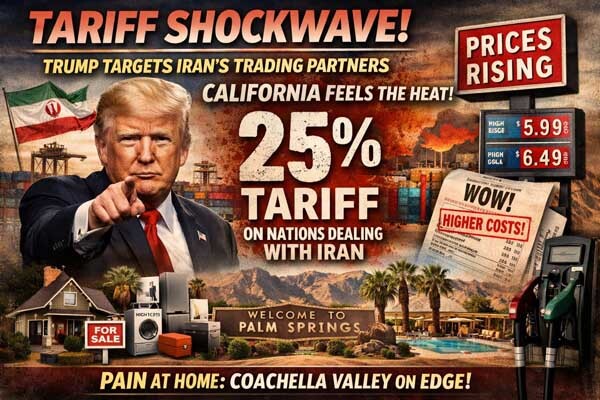
Tariff Shockwave: Trump Targets Iran’s Trading Partners —
Who Pays the Price, and How It Hits California
President Donald Trump dropped a fresh trade bombshell Monday, announcing that the United States will immediately impose a 25% tariff on any country that does business with Iran. The declaration, posted bluntly on Truth Social, was described by the president as “final and conclusive,” setting off instant uncertainty across global markets.
What remains unclear is almost everything else.
The White House has offered no guidance on how the tariff would be enforced or what level of trade qualifies as “doing business” with Iran. That ambiguity alone is rattling importers, exporters, and consumers — especially in trade-heavy states like California.
So, who actually pays the tariff?
Despite the tough talk, tariffs are paid by U.S. importers, not foreign governments. American companies bringing goods into the country would owe the added tax at the border. Those costs are typically passed down the line — to retailers, and ultimately to consumers.
In plain terms: Americans pay first.
Why this matters for California — and the Coachella Valley
California is the nation’s largest importing state, heavily dependent on global supply chains for electronics, vehicles, appliances, clothing, construction materials, and food products. If major U.S. trading partners — especially China — are swept into the tariff net due to any commercial ties with Iran, duties on everyday goods could surge dramatically.
For the Coachella Valley and the greater Palm Springs area, the impact would be felt quietly but quickly:
Higher prices on home improvement materials and appliances, increased costs for hotel and resort supplies, pricier vehicles and parts, and additional pressure on small retailers already coping with high rents, insurance, and labor costs. Tourism-driven businesses operate on tight margins — and tariffs squeeze from the outside in.
Who hurts more — the U.S. or Iran?
In the short term, the U.S. economy feels the pain faster. Iran’s economy is already heavily sanctioned and largely disconnected from U.S. trade. The pressure instead lands on countries that trade with both Iran and the United States — and on American consumers caught in the middle.
Over time, Iran could face reduced indirect trade and financial isolation if partners pull back to avoid U.S. penalties. But that pressure builds slowly. Sticker shock at the checkout counter happens immediately.
Bigger stakes ahead
Trump is again relying on the International Emergency Economic Powers Act to justify sweeping tariffs — authority now under review by the U.S. Supreme Court. If the court rules the president exceeded his powers, the government could be forced to refund an estimated $130 billion in past tariff revenue, adding legal risk to economic uncertainty.
For now, markets, businesses, and local economies are left waiting — and watching. Until details emerge, one thing is clear: this tariff threat isn’t abstract geopolitics. From California ports to Palm Springs storefronts, the ripple effects could land right at home — and in our wallets.
 News Staff
 -
-
Business
Iran
Tariff Shockwave
Global Trading Partners
-
1.5K views -
0 Comments -
0 Likes -
0 Reviews
-
-
Business
Iran
Tariff Shockwave
Global Trading Partners
-
1.5K views -
0 Comments -
0 Likes -
0 Reviews





 Loading ...


