DLNews Biz
SpaceX Hits Earth
NEW YORK — Elon Musk’s SpaceX has encountered some serious turbulence on Wall Street.
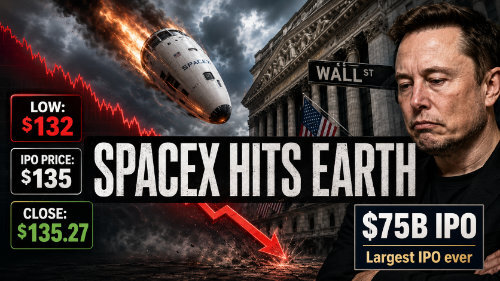
Barely a month after staging the largest initial public offering in history, shares of the rocket, satellite and artificial-intelligence company briefly dropped below their $135 issue price Wednesday—an unwelcome milestone for one of the most hyped stock-market debuts in years.
SpaceX shares fell as low as roughly $132 during trading on July 15 before recovering to close at $135.27. That means the stock technically finished just above its IPO price, but the intraday fall erased nearly all the gains enjoyed by investors who bought shares in the original offering.
The reversal has been dramatic. SpaceX began trading on the Nasdaq under the ticker SPCX on June 12 and closed its first session at $160.95, a gain of about 19 percent from the $135 offering price. The shares later climbed above $200 before investor excitement cooled and the stock began sliding back toward Earth.
The historic IPO raised approximately $75 billion through the sale of more than 555 million shares, valuing SpaceX at about $1.77 trillion before trading began. At its post-IPO peak, the company’s market value briefly exceeded $2.6 trillion, sharply increasing Musk’s already enormous paper fortune.
But beneath the blockbuster debut lies a costly financial gamble.
SpaceX reported a net loss of approximately $4.94 billion for 2025 after incorporating the results of Musk’s artificial-intelligence operations. Investors are now debating whether the company’s fast-growing Starlink satellite network, launch business and ambitious AI plans can eventually justify its massive valuation.
A central part of the sales pitch is the possibility of building artificial-intelligence computing infrastructure in orbit. SpaceX argues that space-based data centers could eventually tap continuous solar power while supporting an enormous global AI market.
The company estimated its measurable total addressable market at approximately $28.5 trillion, including $26.5 trillion connected to artificial intelligence. However, those figures represent potential markets—not guaranteed SpaceX revenue.
Technical obstacles remain formidable. Orbital computing systems would have to withstand radiation, manage heat without conventional terrestrial cooling and operate economically despite huge launch and construction costs.
For now, the drop below the IPO price does not amount to a corporate collapse. Newly listed stocks are often volatile, and SpaceX remains one of the world’s most valuable companies.
Still, the message from Wall Street was unmistakable: Even Musk’s rockets are not immune to gravity.
 News Staff
 -
-
Business
Elon Musk
Nasdaq Composite
Wall Street.
SpaceX
-
417 views -
0 Comments -
0 Likes -
0 Reviews
-
-
Business
Elon Musk
Nasdaq Composite
Wall Street.
SpaceX
-
417 views -
0 Comments -
0 Likes -
0 Reviews





 Loading ...


