Zacharia’s Brief White House Exit
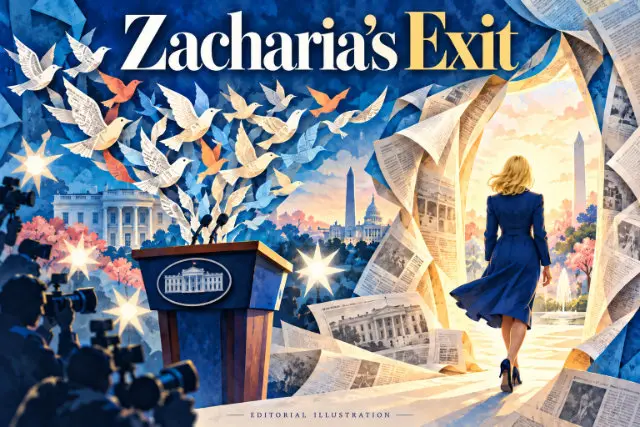
Katie Zacharia’s first White House briefing lasted less than 15 minutes. By Friday, Oct. 16, her tenure as President Donald Trump’s press secretary was ending, overtaken by questions about her legal credentials and readiness for one of Washington’s most demanding public jobs.
Was she fired or did she resign? Reuters reported that she was fired, citing two U.S. officials. The White House’s description was softer: she was “transitioning out.” The most accurate account is that administration officials described a dismissal, while Trump publicly presented departure as something she should consider. The reporting did not establish that she chose to resign independently.
The timeline also needs clarification. Trump announced her selection on Oct. 9, and she began work on Monday, Oct. 12. Her departure emerged on Friday, Oct. 16—her fifth calendar day in the position, four days after starting. Describing her tenure as less than a week avoids the conflicting “four days” and “five days” accounts.
Earlier Friday, Trump said he had encouraged her to reconsider the assignment.
“I said to her honestly, ‘If I were you, I’d reconsider,’” he told reporters. He also defended her against what he considered harsh media treatment. Those remarks suggested declining confidence in her suitability, even as he continued to express personal support.
At the center of the controversy was a distinction between graduating from law school and being licensed to practice law.
Zacharia earned a law degree from Pepperdine University in 2011. She acknowledged Thursday that she had failed the California bar examination and had not taken it again. Trump had described her as an attorney, and she had publicly called herself a lawyer.
Zacharia defended those descriptions, saying she had received advice that her degree and international legal experience allowed her to describe herself as a lawyer. She also maintained that she had worked in international transaction law with appropriate credentials.
Legal experts disputed her interpretation. A watchdog complaint sought an investigation, but a complaint is not a finding of wrongdoing. Describing her as having fabricated her education would therefore be inaccurate; the dispute concerned her professional status and how she represented it.
Her Tuesday briefing added to the scrutiny. She read extensively from prepared remarks and called on three reporters. Zacharia subsequently said the short format was intentional because Trump would speak with reporters himself. The White House initially praised her performance in an official release.
The press secretary’s assignment extends well beyond answering questions on television. The office explains presidential decisions, gathers information from administration officials, responds to reporters, distributes statements, helps prepare the president for interviews and news conferences, and coordinates press arrangements for official travel.
Former press secretary Josh Earnest described its central purpose as helping Americans understand what the president is doing and why.
That creates an unusually difficult balancing act. The spokesperson advocates for the president while answering an independent press whose responsibility includes challenging the administration. Effective performance requires access to decisions, command of detailed policy, sound judgment about confidential information and enough credibility that answers remain useful when the news is unfavorable.
The institutional tension exists under presidents of both parties. A spokesperson can face questions about military operations, economic figures, court decisions and personnel disputes in the same briefing, often while events are still developing.
Under Trump, his frequent direct exchanges with reporters add another consideration: the press secretary speaks for a president who often prefers to speak for himself. Zacharia explicitly cited that preference when explaining her abbreviated briefing.
As for why women appear to dominate the position, that is a recent pattern rather than its historical character. Dee Dee Myers became the first woman to hold the job in 1993; by 2014, only Myers and Dana Perino had done so.
Trump has appointed substantially more women than men as press secretary across his two terms. Following Sean Spicer, his choices included Sarah Huckabee Sanders, Stephanie Grisham, Kayleigh McEnany, Karoline Leavitt and Zacharia.
That reflects presidential hiring choices. It does not establish that women are inherently better suited to the work or explain any individual departure.
Leavitt’s exit was publicly presented differently: she left at the end of August to spend more time with her family, with Trump expressing support for that decision. Her departure should not be treated as equivalent to Zacharia’s reported dismissal.
Zacharia’s exit followed a documented credentials controversy and a difficult debut. Public reporting supports describing her as having been let go. It does not establish that any single controversy was the sole reason for the decision.
 News Staff
 -
-
Business
Washington DC
press secretary
Katie Zacharia
Briefest Tenure
-
88 views -
0 Comments -
0 Likes -
0 Reviews
-
-
Business
Washington DC
press secretary
Katie Zacharia
Briefest Tenure
-
88 views -
0 Comments -
0 Likes -
0 Reviews





 Loading ...


