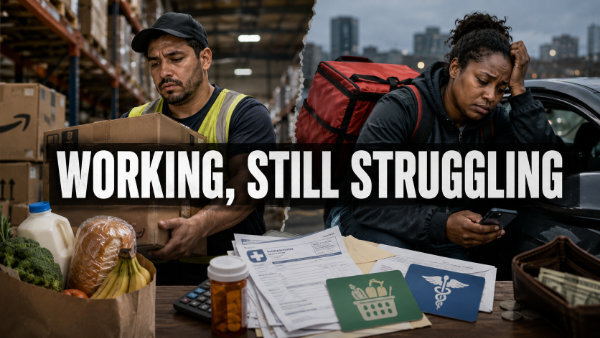
Working but Still Needing Help
A growing number of workers employed by some of America’s largest companies—including Amazon, Walmart, FedEx and leading gig-economy platforms—are relying on public food and healthcare programs to make ends meet, according to a new report from the U.S. Government Accountability Office.
The nonpartisan congressional watchdog found that millions of Americans who worked during 2024 remained enrolled in Medicaid or lived in households receiving benefits through the Supplemental Nutrition Assistance Program, commonly known as SNAP or food stamps.
Using U.S. Census Bureau data, the GAO estimated that nearly 14 million working-age adults enrolled in Medicaid held a job at some point during 2024. Another 10.6 million working adults lived in households receiving SNAP benefits.
About two-thirds of the working recipients in both programs reported working full-time schedules of at least 35 hours a week. Most were employed in the private sector, with transportation, food preparation, restaurant service and retail sales among the most common occupations.
The findings suggest that employment alone does not necessarily protect families from financial hardship, particularly when workers face limited hours, unpredictable schedules, high housing costs or jobs that do not provide affordable health insurance.
Amazon Enrollment Nearly Triples
The GAO also examined administrative information supplied by agencies across 11 states representing approximately one-fifth of the U.S. population.
The state information reflected employment and benefit enrollment as of September.
Across the states reviewed, nearly 12,350 Amazon employees were enrolled in SNAP, while approximately 11,350 were receiving Medicaid coverage. Those figures were nearly three times the comparable totals identified in the GAO’s previous analysis released in 2020.
Amazon’s rapid workforce expansion partly contributed to the increase. The company’s overall employment grew substantially during and after the COVID-19 pandemic as online shopping, delivery services and warehouse operations expanded.
Nevertheless, the rising enrollment figures have renewed questions about whether jobs at some of the nation’s most profitable corporations provide sufficient income and benefits for workers and their families.
Sen. Bernie Sanders of Vermont, who requested both GAO studies, said taxpayers should not be responsible for supplementing wages paid by highly profitable companies.
“No one who works for a company making billions in profits should be living in poverty,” Sanders said in a statement.
Sanders has long argued that companies such as Amazon and Walmart benefit indirectly when government programs provide food and healthcare assistance to employees who cannot afford those necessities through their wages and workplace benefits.
Amazon Challenges the Interpretation
Amazon disputed the suggestion that the enrollment numbers demonstrate that the company pays inadequate wages.
Company spokesperson Rachael Lighty said benefit eligibility is determined by total household income and family size rather than the wages earned by one individual. She also argued that employers offering part-time schedules are more likely to have workers who qualify for assistance.
Amazon said using raw enrollment numbers without considering the size and growth of its workforce creates a misleading picture.
The company maintains that its pay is among the strongest in the warehouse and transportation industries. Regular full-time employees can obtain company health coverage beginning on their first day, with individual plans available for as little as $5 a week, according to Amazon.
The company announced a $1 billion investment in late 2025 to increase wages and reduce healthcare expenses for U.S. fulfillment and transportation workers. Amazon said the investment raised average base pay for those employees to more than $23 an hour.
Gig Platforms Rise in the Rankings
The report also highlighted a major increase in benefit recipients earning money through app-based rideshare and delivery services.
Uber, Lyft, DoorDash, Grubhub and Instacart collectively became leading sources of employment among SNAP and Medicaid recipients in several of the states studied. Those companies had barely appeared in comparable employer rankings five years earlier.
Gig companies generally classify drivers and delivery workers as independent contractors rather than traditional employees. That means workers typically do not receive guaranteed hours, paid leave or employer-sponsored health insurance.
Their earnings can also fluctuate significantly depending on customer demand, local competition, fuel prices and vehicle-maintenance costs.
Industry representatives argue that gig work provides flexibility and allows people to earn supplemental income during job losses, reduced working hours or other financial disruptions. Labor advocates counter that the absence of guaranteed wages and benefits leaves many drivers with unstable incomes after expenses.
The GAO did not conclude that any individual employer directly caused its workers to qualify for assistance. Eligibility may reflect household size, income earned by other family members, part-time schedules and other circumstances.
However, the report found that dozens of companies appeared among the leading employers of SNAP or Medicaid recipients in at least two of the states reviewed. Several were among the nation’s largest corporations by workforce size.
Walmart Remains Prominent
Walmart remained one of the leading employers of benefit recipients in every state examined, continuing a pattern identified in the 2020 report.
The retailer is the nation’s largest private employer and employs many workers in entry-level retail and warehouse positions. Walmart said it has raised starting wages for store associates by 93% since 2015 and that its associates now earn approximately $18 an hour on average.
FedEx also recorded a substantial increase. The number of FedEx workers receiving Medicaid more than tripled in the states studied, while the number participating in SNAP nearly doubled.
The increases do not necessarily indicate that wages at those companies declined. Workforce growth, changes in benefit enrollment, household circumstances and improved state reporting can all affect the totals.
Millions Work While Receiving Assistance
The broader national findings show that working recipients are not limited to a handful of large corporations.
The GAO estimated that nearly 14 million Medicaid recipients worked during 2024, compared with approximately 12 million working recipients identified in the earlier report. About 10.6 million working adults lived in SNAP households, compared with roughly 9 million in the previous analysis.
Approximately 88% of working SNAP and Medicaid recipients were employed in the private sector.
Although about two-thirds usually worked at least 35 hours a week, they were less likely than workers outside the programs to maintain full-time schedules for at least 50 weeks during the year. That distinction suggests that inconsistent schedules, seasonal employment and periods without work may contribute to benefit eligibility.
SNAP generally serves households with incomes near or below the federal poverty level, although eligibility limits vary by state and household circumstances. Medicaid eligibility also differs by state, particularly between states that expanded coverage under the Affordable Care Act and those that did not.
Rules Are Becoming More Restrictive
The report was released as federal rules governing SNAP and Medicaid are becoming more restrictive.
Expanded SNAP work requirements are already taking effect for many adults. Recipients may be required to work, volunteer, attend school or participate in job training for at least 80 hours a month to retain assistance.
A new federal Medicaid work requirement is also scheduled to take effect in most states. Supporters argue that the requirements will encourage employment, reduce long-term dependency and help recipients move toward financial independence.
Critics contend that many recipients already work and could lose benefits because their hours fluctuate or because they have difficulty completing required paperwork. They also warn that losing food or healthcare assistance could make it harder for people to remain employed.
States are simultaneously preparing for reductions in federal support for the safety-net programs.
New Jersey recently imposed an annual assessment on companies with at least 50 full-time workers receiving Medicaid. Depending on the number of covered workers, businesses are charged between $325 and $725 annually for each qualifying employee or dependent.
Supporters say the policy will require large employers to share more of the cost of covering their workers. Business organizations argue that companies should not be penalized when employees qualify for Medicaid because of family size or voluntarily decline employer-sponsored insurance.
The GAO report does not resolve that debate. It does, however, document a persistent feature of the American economy: Millions of people are working, many of them full time, while still depending on taxpayer-supported programs for groceries and medical care.
For corporations, lawmakers and taxpayers, the central question is whether those programs are providing temporary support to working families—or becoming a permanent part of the business model for low-wage and gig-economy employment.
 News Staff
 -
-
Business
Fedex
SNAP
U.S. Census Bureau
Amazon
Walmart
Medicaid
-
63 views -
0 Comments -
0 Likes -
0 Reviews
-
-
Business
Fedex
SNAP
U.S. Census Bureau
Amazon
Walmart
Medicaid
-
63 views -
0 Comments -
0 Likes -
0 Reviews