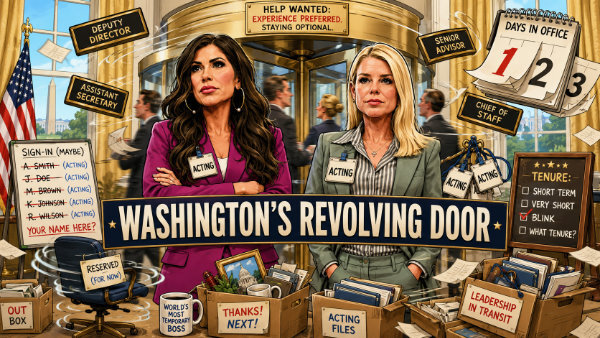
Washington’s Revolving Door
WASHINGTON — The federal government has many long-standing traditions: lengthy forms, confusing acronyms, meetings about future meetings and, increasingly, senior officials leaving before everyone has learned where the break room is.
A review by the nonpartisan Partnership for Public Service found that 27 Senate-confirmed officials across 13 Cabinet departments departed during the first 18 months of President Donald Trump’s second administration. That is more than double the 11 departures recorded during the comparable period of Trump’s first term.
In practical terms, Washington’s executive leadership chart is beginning to resemble a restaurant menu printed with the warning: “Selections and personnel subject to change.”
Among the high-profile departures were Secretary of the Navy John Phelan and Centers for Disease Control and Prevention Director Susan Monarez. Both had previously gone through the Senate confirmation process, which involves background reviews, committee hearings, questioning and a final vote—an elaborate procedure that apparently does not always come with a long-term parking permit.
The analysis did not include ambassadors, U.S. attorneys or U.S. marshals, meaning the full federal employment shuffle may be broader than the report’s official count.
The Partnership also found that the administration has submitted fewer nominations than during Trump’s first term, leaving more positions vacant or temporarily occupied by acting officials. In other words, the confirmation line is moving, but fewer people appear to be standing in it.
Acting officials are nothing new. Presidents from both parties have relied on temporary appointments while waiting for permanent nominees to be selected and confirmed. The concern arises when “temporary” begins to feel less like a bridge and more like a furnished apartment.
Chris Piper of the Partnership for Public Service warned that turnover at this level could weaken government leadership while shifting more authority toward the White House.“Turnover on this scale does not just thin the government’s leadership ranks—it concentrates power in the president,” Piper wrote.
The White House rejected suggestions that the departures reflect instability.
“President Trump has the most talented Cabinet in American history who work every day to implement his common sense, America First agenda,” spokesperson Olivia Wales said in a statement.
That leaves Washington with two competing interpretations. One says the administration is rapidly adjusting its roster to achieve its goals. The other says federal agencies need experienced, Senate-confirmed leaders who remain in place long enough to remember their computer passwords.
The growing use of acting officials has also drawn attention because temporary leaders can serve without completing the full Senate confirmation process. Critics argue that this may weaken congressional oversight, while supporters say it gives presidents flexibility when vacancies arise.
Trump defended the practice during his first term, saying acting appointments gave him more freedom in managing the government.
Either way, the federal machinery continues operating. The lights remain on, the paperwork continues multiplying and somewhere in Washington, another office nameplate is probably being loosened—just in case.
 News Staff
 -
-
Business
Washington DC
Public Service short term
-
90 views -
0 Comments -
0 Likes -
0 Reviews
-
-
Business
Washington DC
Public Service short term
-
90 views -
0 Comments -
0 Likes -
0 Reviews