War and Windfalls: Who Profits as the Iran Conflict Shakes the Global Economy
Fireballs lighting the skies over Tehran after American and Israeli strikes on Iranian oil depots have not only intensified one of the most dangerous Middle East confrontations in decades—they have also rattled global markets and triggered a surge of profits in several powerful industries.
As the conflict escalates, oil prices have jumped sharply, fueling volatility across energy markets and pushing gasoline costs higher for American drivers. While rising fuel prices strain household budgets across the United States, some sectors of the economy are seeing the opposite effect: booming business.
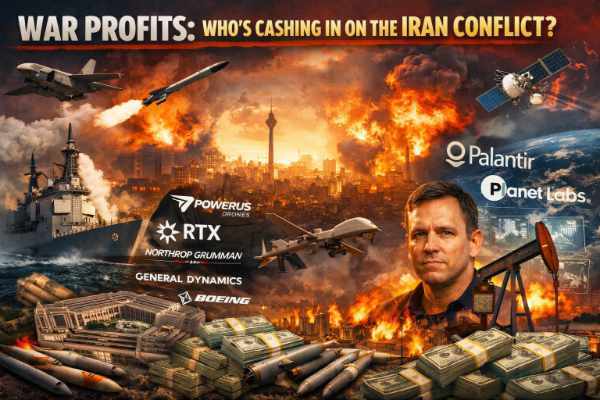
At the top of the list are major American defense contractors. The so-called “Big Five” of the U.S. arms industry — Lockheed Martin, RTX Corporation, Northrop Grumman, General Dynamics, and Boeing — are already seeing strong demand for the kinds of weapons systems now dominating the battlefield.
“These companies build exactly the systems that are used most heavily in modern conflicts,” said William Hartung, a senior research fellow at the Quincy Institute for Responsible Statecraft. Cruise missiles, interceptors, advanced radar systems, and combat aircraft are among the most expensive pieces of military hardware deployed during high-intensity warfare.
A single U.S. Navy destroyer, for example, can carry up to 90 Tomahawk cruise missiles, each costing roughly $2.5 million. With military operations expanding across the region, demand for such systems can quickly translate into billions of dollars in new contracts.
Technology companies tied to modern warfare are also benefiting. The data-analytics firm Palantir Technologies — co-founded by billionaire investor Peter Thiel — provides artificial-intelligence software used for battlefield analysis, targeting and intelligence operations. The company’s shares recently climbed as investors anticipated increased defense spending tied to the conflict.
Satellite imaging firms are seeing similar momentum. Planet Labs, which supplies high-resolution Earth observation data to government agencies including the Pentagon, stands to gain from expanded demand for AI-assisted surveillance and reconnaissance.
Meanwhile, the war's political dimension has added another layer of controversy. Reports indicate that members of the president’s family are exploring opportunities in the rapidly growing drone sector. Business plans involving a drone company called Powerus, have raised questions about potential future government contracts amid rising military demand for unmanned systems.
Economic analysts say the pattern is familiar in wartime economies. “War is the most brutal form of industrial policy,” said media and economic commentator Nadja Atwal. “Billions flow into weapons production, paid by taxpayers and ultimately captured by corporate shareholders.”
For Hartung, the current conflict could become one of the most lucrative periods in decades for America’s defense industry. Yet it also raises uncomfortable political questions. During the campaign, President Trump promised to crack down on war profiteering.
Now, critics argue, the economic winners of the conflict appear to be the very industries once targeted for reform.
As missiles fly and oil prices climb, the battlefield is not the only place where the stakes are rising. In Washington and on Wall Street, the war is shaping up to be not just a geopolitical crisis—but a multi-billion-dollar business.

 News Staff
 -
-
Business
Lockheed Martin
RTX Corporation
Northrop Grumman
General Dynamics
and Boeing
-
222 views -
0 Comments -
0 Likes -
0 Reviews
-
-
Business
Lockheed Martin
RTX Corporation
Northrop Grumman
General Dynamics
and Boeing
-
222 views -
0 Comments -
0 Likes -
0 Reviews