JustTheFactMax
Pipeline Power Play: Saudis Reroute Oil Around Hormuz Crisis
Riyadh — As tensions around the Strait of Hormuz continue to rattle global energy markets, Saudi Arabia is leaning on a decades-old strategic asset to keep oil flowing—and calm at least part of the storm.
Recent reports indicate that Saudi Arabia is maximizing use of its East-West Pipeline, also known as the Petroline, a roughly 1,200-kilometer route stretching from oil fields in the Eastern Province to the Red Sea port of Yanbu. The move allows the kingdom to bypass the Strait of Hormuz entirely, a narrow but critical chokepoint through which roughly one-fifth of the world’s oil supply typically passes.
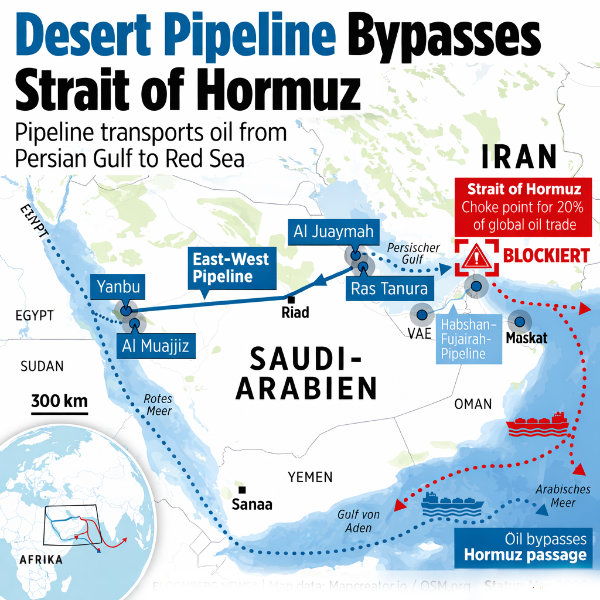
While claims of a complete blockade of Hormuz remain unconfirmed, heightened military tensions and shipping risks in the region have already disrupted tanker traffic and driven oil prices upward. In response, Saudi Arabia appears to be shifting more crude transport inland, reducing reliance on vulnerable oil shipping lanes.
Industry estimates place the Petroline’s capacity at approximately 5 to 7 million barrels per day, though actual export volumes are often lower due to domestic consumption and operational constraints. Saudi Aramco has not publicly confirmed current throughput levels, but CEO Amin Nasser previously stated the system was ready to operate near full capacity if needed.
The pipeline itself is not new. Built in 1981 during the Iran-Iraq War, it was designed specifically to provide an alternative export route during regional conflicts. Its relevance today underscores how geopolitical risk continues to shape global energy infrastructure decades later.
Saudi Arabia is not alone in seeking alternatives. The United Arab Emirates operates the Abu Dhabi Crude Oil Pipeline, which routes oil from inland fields to the port of Fujairah on the Gulf of Oman, also bypassing Hormuz. Still, these alternatives can only offset a portion of the total oil flow that normally transits the strait.
Energy analysts caution that while the Petroline offers a crucial buffer, it is not a complete solution. The system has faced security threats before, including drone attacks in recent years, highlighting its vulnerability at a moment when it has become one of the world’s most critical energy lifelines.
For now, the Saudi pivot provides a measure of stability in an otherwise volatile market—but the broader picture remains uncertain. As long as tensions persist near Hormuz, global oil prices and supply chains are likely to remain on edge.

 JustTheFacts Max
 -
-
Business
JustTheFactsMax
Saudi Arabia
East-West Pipeline
Petroline
-
51 views -
0 Comments -
0 Likes -
0 Reviews
-
-
Business
JustTheFactsMax
Saudi Arabia
East-West Pipeline
Petroline
-
51 views -
0 Comments -
0 Likes -
0 Reviews