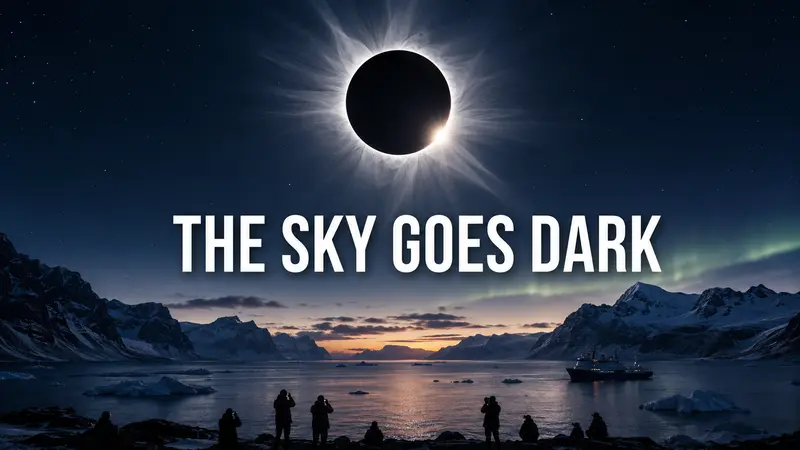
The Sky Goes Dark
On Wednesday, August 12, daylight will briefly surrender to darkness as the moon’s shadow races across the top of the world and into Europe, creating the only total solar eclipse of 2026.
For those fortunate enough to stand inside the narrow path of totality, the experience will be far more dramatic than simply watching the sun disappear. Temperatures may fall, bright planets and stars can emerge, animals may react as though night has arrived, and the sun’s ghostly outer atmosphere—the corona—will suddenly surround the black silhouette of the moon.
Totality will be visible from parts of northern Russia, Greenland, Iceland, northern Spain and a tiny corner of northeastern Portugal. The shadow will also sweep across a long stretch of the Arctic and Atlantic oceans. At the point of greatest eclipse, totality will last approximately two minutes and 18 seconds.
Many more people across Canada, the northern and eastern United States, Europe and northwestern Africa will see a partial eclipse, with the moon covering varying portions of the sun.
The eclipse occurs because the moon passes almost perfectly between Earth and the sun. Although the sun is about 400 times wider than the moon, it is also roughly 400 times farther away. From Earth, the two objects therefore appear nearly the same size—one of nature’s most remarkable coincidences.
The moon’s darkest central shadow, called the umbra, is relatively narrow. Only observers standing within that moving shadow will experience totality. Those inside the broader, lighter penumbra see a partial eclipse, while everyone outside both shadows sees an ordinary sunny day.
Eclipse cartographer Michael Zeiler will be among those traveling far from home for the event. Zeiler, founder of EclipseAtlas.com and a veteran eclipse chaser, is aboard the expedition ship Ocean Explorer, heading toward Greenland’s fjords.
His goal goes beyond seeing another total eclipse. Zeiler hopes conditions will allow him to observe an aurora during totality—something never previously documented in that setting. Because the eclipse coincides with the Perseid meteor shower, he may even catch a meteor crossing the darkened sky. Seeing all three phenomena together would require an extraordinary combination of solar activity, darkness, clear weather and luck.
Scientists, however, do not need luck to know where the eclipse will appear. Astronomers use precise measurements of the sun, moon and Earth, along with sophisticated computer models, to calculate eclipse paths centuries in advance.
The predictions are remarkably accurate, although the exact edges of totality can still shift slightly. The moon is not a perfectly smooth sphere; mountains and valleys along its edge allow beads of sunlight to shine through immediately before and after totality. These flashes, known as Baily’s Beads, are among the eclipse’s most beautiful sights.
Can the Coachella Valley See It?
Unfortunately, the August 12 solar eclipse will not be visible from Palm Springs, Palm Desert or the rest of the Coachella Valley—not even as a partial eclipse. Southern California lies outside the moon’s shadow for this event. Local residents can still watch NASA’s live coverage beginning at approximately 10:15 a.m. Pacific time. The worldwide maximum occurs at about 10:46 a.m. Pacific.
But the Coachella Valley will not be left entirely out of the celestial celebration. The Perseid meteor shower reaches its peak during the night of August 12 into the early morning of August 13. With a new moon keeping the sky unusually dark, desert observers away from city lights could enjoy one of the year’s finest meteor displays, weather permitting.
Anyone viewing the eclipse from an affected region must use certified eclipse glasses or a safe indirect viewing method. Ordinary sunglasses are not sufficient. Only people inside the path of totality may briefly remove eclipse glasses—and only during the short period when the sun is completely covered.
The next total solar eclipse will occur on August 2, 2027, crossing southern Spain, North Africa and parts of the Middle East. A total eclipse will not return to portions of the contiguous United States until August 23, 2044.
For eclipse chasers, the wait and the travel are worth it. Totality lasts only minutes, but those who experience the rushing shadow, sudden darkness and glowing corona often spend years planning to see it again.
 Max Liebermann
 -
-
Society
solar eclipse of 2026
-
138 views -
0 Comments -
0 Likes -
0 Reviews
-
-
Society
solar eclipse of 2026
-
138 views -
0 Comments -
0 Likes -
0 Reviews