The Great Hydration Break Debate: When Player Safety Becomes a Commercial Timeout
DLNews/Opinion
The 2026 FIFA World Cup has given fans plenty to talk about, but one of the biggest controversies isn’t a goal, a referee decision, or even a star player. It’s the now-famous hydration break.
On paper, the idea sounds impossible to oppose. Players are competing in North American summer heat, often in high humidity. Medical experts have repeatedly warned about the dangers of heat stress, dehydration, and declining cognitive performance during elite competition. Research supports the need for cooling strategies when temperatures become extreme.
But that’s not where the controversy lies.
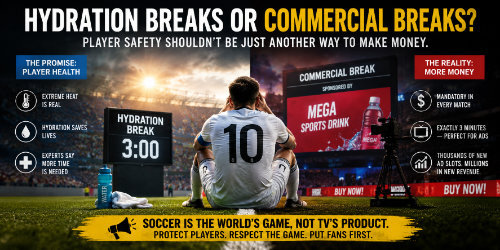
The problem is that FIFA didn’t simply introduce hydration breaks for matches played in brutal heat. Instead, it mandated three-minute breaks in every World Cup match, regardless of weather conditions, stadium design, or actual risk levels. Even matches played in rain, mild temperatures, or climate-controlled venues have been interrupted. Fans have responded with loud boos in stadiums from Toronto to Dallas, questioning whether these stoppages are really about player welfare.
Many experts and players have raised a different concern. If the breaks were truly about health, why are they only three minutes long?
Sports scientists interviewed during the tournament argued that meaningful cooling often requires five to six minutes, along with cold towels, ice, and more comprehensive recovery measures. Several medical specialists have suggested the current format may be too short to significantly reduce heat stress in the most dangerous conditions.
That leads to the uncomfortable question many fans are asking:
If three minutes isn’t enough for maximum health benefits, why is it exactly long enough for television commercials?
For the first time in World Cup history, FIFA has allowed broadcasters to sell advertising during these mandatory stoppages. Industry analysts openly described the breaks as new commercial inventory, creating additional advertising opportunities during a sport traditionally celebrated for its uninterrupted flow.
Soccer’s uniqueness has always been its rhythm. Unlike American football, baseball, or basketball, the game flows continuously. There are no television timeouts. No commercial interruptions every few minutes. For generations, fans have cherished those uninterrupted 45-minute halves.
Now that sacred tradition is being chipped away.
Even some players have questioned the need for mandatory breaks in cooler conditions, while coaches have admitted they use them as tactical timeouts to reorganize teams and change strategy. The result is that matches increasingly feel divided into quarters rather than halves.
To be clear, protecting players should never be controversial. If temperatures are dangerous, stop the game. Give players water. Give them shade. Give them five minutes if necessary.
But fans are right to be skeptical when a universal health measure conveniently creates thousands of new advertising slots worth millions of dollars. The optics are terrible.
A better solution would be common sense: allow hydration breaks only when weather conditions warrant them, as was done in previous tournaments. Alternatively, use heat-based thresholds determined by medical professionals rather than blanket mandates. That would preserve both player safety and the integrity of the sport.
The World Cup belongs to the players and the fans—not television executives
Because once soccer starts scheduling stoppages around commercial opportunities, the world’s game risks becoming just another televised product.
And that’s a much bigger problem than dehydration.
 News Staff
 -
-
Sports
Football
Soccer
2026 FIFA World Cup
hydration break
Commercial Timeout
-
699 views -
0 Comments -
0 Likes -
0 Reviews
-
-
Sports
Football
Soccer
2026 FIFA World Cup
hydration break
Commercial Timeout
-
699 views -
0 Comments -
0 Likes -
0 Reviews






 Loading ...


