The Billionaire Ballot Clash: California’s Prop. 39
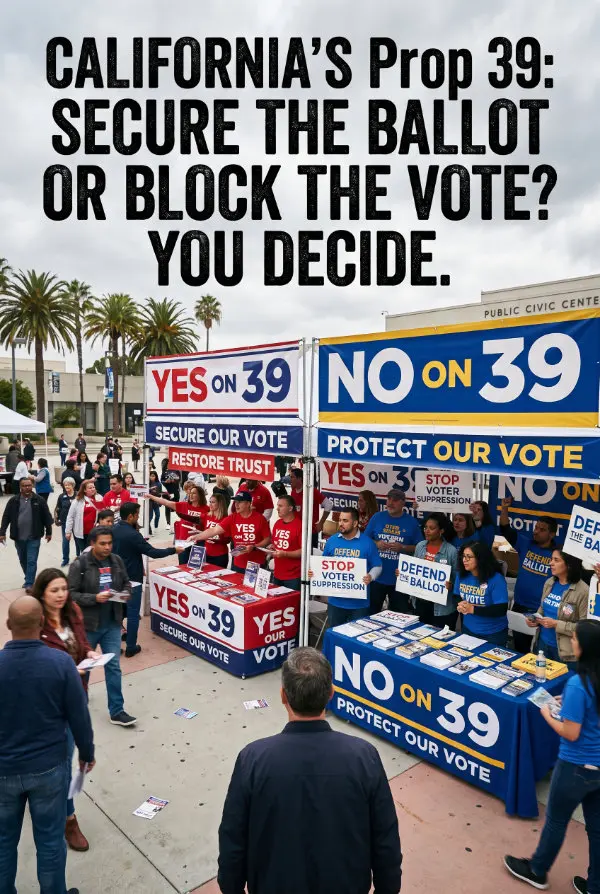
California’s Proposition 39 has ignited one of the fiercest and most expensive ballot fights of the season, putting voter identification and election administration squarely before voters. The initiative proposes amending the state constitution to require registered voters to verify their identification—either at in-person polling locations or via specific identifying numbers on mail-in ballot envelopes—along with mandating regular citizenship checks of voter rolls and independent election audits.
Official materials and nonpartisan breakdowns are available through the California Secretary of State's Official Voter Information Guide
The debate presents two sharply contrasting philosophies on democratic participation:
The Argument for "Yes": Proponents contend that establishing standard identification protocols restores public confidence and safeguards election integrity. Backers emphasize that everyday life routinely requires government-issued identification, framing the initiative as a common-sense measure to align California with numerous other states, deter theoretical illegal voting, and maintain accurate voter rolls through routine verifications.
The Argument for "No": Opponents argue the measure creates unnecessary, costly barriers designed to suppress legitimate voter turnout. Civil rights advocates and election analysts warn that strict identification mandates disproportionately disenfranchise students, low-income citizens, seniors, and minority communities who lack accessible documentation. They point out that existing voter verification, signature matching, and criminal penalties already keep fraudulent voting exceedingly rare while cautioning that new bureaucratic requirements could delay vote counting and risk voter privacy.
What elevates Prop. 39. From a standard policy debate into a high-stakes brawl is the massive influx of outside capital. Major conservative figures, venture capitalists, and GOP megadonors—including tech investors like the Winklevoss twins and high-profile political donors—have poured tens of millions into the "Yes" campaign. Analysts observe that national donors view California as a testing ground: testing whether conservative voting measures can gain traction in deep-blue territory to provide a blueprint for moderate swing states. In response, labor unions, civil liberties organizations, and Democratic-aligned groups have raised substantial counter-funds to defend California's ballot access models.
For Californians, the measure is less about abstract legal technicalities and more about the delicate balance between election accessibility and voting verification—leaving voters to decide whether security concerns or voting access take precedence at the ballot box.
 News Staff
 -
-
Business
California’s Proposition 39
yes/No
-
84 views -
0 Comments -
0 Likes -
0 Reviews
-
-
Business
California’s Proposition 39
yes/No
-
84 views -
0 Comments -
0 Likes -
0 Reviews





 Loading ...


