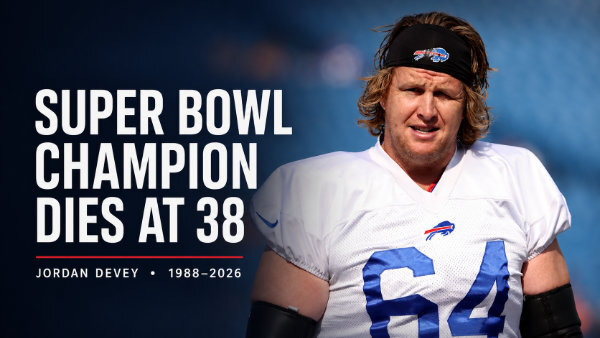
Super Bowl champion Jordan Devey dies at 38
The world of American football is mourning former NFL offensive lineman and Super Bowl champion Jordan Devey, who has died by suicide at the age of 38.
His family announced the devastating news on social media. Devey’s death came shortly before what would have been his 15th wedding anniversary with his wife, Linsey, making an already painful loss even more heartbreaking for those closest to him.
In an emotional tribute, Linsey remembered her husband as the center of their family.
“You were our hero, and our hearts hurt because you are no longer with us,” she wrote. “We love you. We miss you. And as you said in your last words to me, ‘We’ll talk soon.’”
Devey leaves behind his wife and their four children. For them, his legacy extends far beyond professional football, championship rings and crowded stadiums. He was a husband, a father and, in his wife’s words, their hero.
Born in California, Devey took an unconventional route to the NFL. He did not play organized football until later than many future professionals, but eventually developed into an offensive lineman capable of competing at the highest level of the sport.
He entered the NFL as an undrafted player and went on to spend seven seasons in the league. Devey appeared in 44 regular-season games, starting 21 of them, while representing the New England Patriots, San Francisco 49ers, Kansas City Chiefs, Oakland Raiders and Buffalo Bills.
His greatest team achievement came during the 2014 season, when he was a member of the New England Patriots squad that won Super Bowl XLIX.
Led by quarterback Tom Brady, the Patriots defeated the Seattle Seahawks 28–24 in one of the most dramatic Super Bowls in NFL history. The championship was secured in the closing seconds when New England cornerback Malcolm Butler intercepted a pass near the goal line.
Devey did not take the field in the final, but he had contributed during the championship season, appearing in seven games and making four starts for New England. He shared the Patriots’ offensive-line room with players including German-born tackle Sebastian Vollmer.
After leaving New England, Devey continued his career with several NFL teams. His final involvement in the league came with the Buffalo Bills in 2021.
News of his death has now raised painful questions about what he may have experienced after his playing days ended.
In a television interview, Devey’s parents said they believed their son may have suffered from chronic traumatic encephalopathy, better known as CTE. They spoke about changes and mental-health difficulties that, in their view, could have been connected to the repeated head impacts he experienced during his football career.
It is important, however, to distinguish the family’s concern from a confirmed medical diagnosis. Devey was never conclusively diagnosed with CTE, and his relatives have said that a definitive examination will not be possible in his case.
It would therefore be inaccurate to state as fact that he had the disease. It would also be irresponsible to claim that CTE caused his death.
CTE is a progressive degenerative brain disease associated with a history of repeated impacts to the head. Those impacts do not always cause a diagnosed concussion or produce immediate, visible symptoms. Over time, however, repeated trauma may contribute to changes in the brain.
The condition has been found in former athletes from contact sports such as American football, boxing, ice hockey, rugby and soccer. Military veterans and others exposed to repeated head trauma may also be at risk.
People later found to have CTE have experienced problems involving memory, judgment, concentration and movement. Families have also reported depression, impulsive behavior, emotional instability, aggression and significant changes in personality.
Those symptoms are not unique to CTE and can be caused by numerous other medical or psychological conditions. Their presence alone does not prove that someone has the disease.
At present, CTE can be confirmed only after death through a specialized examination of brain tissue. Researchers are continuing to investigate methods that may one day allow the condition to be reliably identified in living patients.
Public awareness of CTE grew substantially following cases involving former professional athletes. The issue also reached a wider audience through the 2015 film “Concussion,” in which Will Smith portrayed physician Bennet Omalu, whose research helped expose the disease in former NFL players.
Devey’s death will inevitably become part of the broader discussion about repeated head impacts and the responsibilities of contact-sport organizations. That conversation is necessary, particularly when considering how athletes are cared for after their careers have ended.
But his life should not be reduced to an unconfirmed diagnosis or defined solely by the circumstances of his death.
Jordan Devey reached the summit of his sport. He fought his way into the NFL without being drafted, remained there for seven seasons and became a Super Bowl champion. Behind those accomplishments was a man whose family loved him deeply and is now confronting an unimaginable loss.
For football supporters, he will be remembered as a member of a championship team. For his wife and children, he was something more important: their husband, their father and their hero.
If you or someone you know is experiencing a suicidal crisis or severe emotional distress in the United States, call or text 988 for immediate support.
 News Staff
 -
-
Sports
Football
NFL
Jordan Devey
chronic traumatic encephalopathy
CTE
-
489 views -
0 Comments -
0 Likes -
0 Reviews
-
-
Sports
Football
NFL
Jordan Devey
chronic traumatic encephalopathy
CTE
-
489 views -
0 Comments -
0 Likes -
0 Reviews






 Loading ...


