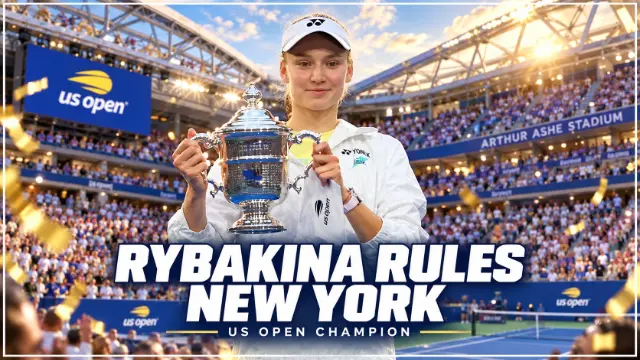
Rybakina Rules New York
NEW YORK — Hollywood had seats. Elena Rybakina had the closing shot.
With an ace, the famously composed Kazakh finished off Aryna Sabalenka and claimed the US Open women’s championship Saturday, September 12. Her arms went up. The tension finally broke. After two hours and 21 minutes, a 6–4, 5–7, 6–2 victory delivered her first Flushing Meadows crown and third Grand Slam singles title.
For a player whose expression can make championship tennis look like another afternoon at practice, this was a moment worth letting show.
Around her, Arthur Ashe Stadium supplied the emotion in abundance. Approximately 23,000 spectators had helped turn the final into an intensely personal occasion for Sabalenka, the two-time defending champion.
“Oh, my God, I feel American over there,” Sabalenka said afterward, describing the support. The crowd had embraced her. Keeping the trophy proved harder.
The celebrity seats offered their own blockbuster cast. Brad Pitt watched alongside Ines de Ramon, with Paris Hilton, Pink, Spike Lee, Jessica Chastain, Amy Adams and Elizabeth Banks also among the spectators. Maria Sharapova, the 2006 champion, was there for a particularly fitting assignment: presenting the winner’s trophy 20 years after lifting it herself.
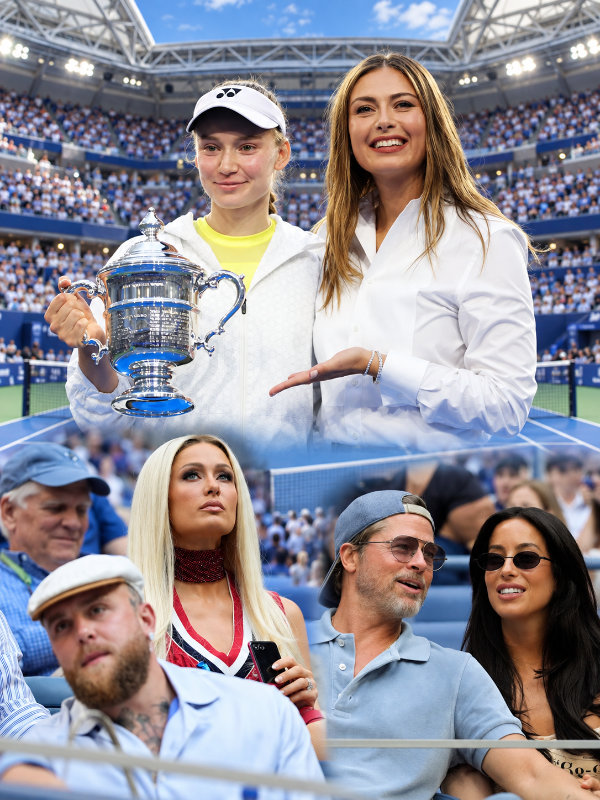
But the central drama belonged to two women carrying enough power in their rackets to make every short ball feel dangerous.
Sabalenka, 28, was appearing in her fourth consecutive US Open final, chasing a third straight championship. Rybakina, 27, had never previously reached the final here. She brought Wimbledon’s 2022 crown and this year’s Australian Open title into the contest.
This was their third Grand Slam final against each other. Sabalenka had won their 2023 Melbourne meeting; Rybakina had reversed that result in January. Now came the New York decider.
The opening set turned on a narrow opportunity. Rybakina broke for 3–2, then protected that advantage. Her first serve was surprisingly elusive—only 27% landed—but her groundstrokes supplied the authority her delivery temporarily lacked.
One break. One set. Sabalenka was behind.
The second set tightened the contest. Service holds kept the scoreboard close, neither player finding an easy route clear. Then, with Sabalenka leading 5–4, the defending champion finally had an opening: two set points on Rybakina’s serve.
Rybakina saved both.
At 5–5, the escape looked significant. Sabalenka, however, kept pressing. She held for 6–5 and earned another set point in the next game. This time, she converted.
Seven–five. One set apiece. The championship was back in the balance.
For Sabalenka, it was a chance to turn survival into a comeback. For Rybakina, it demanded an immediate reset.
The answer came early. Rybakina broke for 2–1 in the deciding set, reclaiming control before Sabalenka could build on her revival. The Belarusian’s frustration became increasingly visible, her racket bouncing against the court as the match slipped away.
Rybakina kept working. At 4–2, a winning volley secured the second break. Now she could serve for the championship.
Her second match point brought the finishing ace—her 12th of the afternoon. She ended with 36 winners against 24 unforced errors, numbers that captured the precision behind her quiet exterior.
At the ceremony, the contrast was poignant: Rybakina celebrating a breakthrough, Sabalenka fighting disappointment.
The new champion admitted that injury concerns had lowered her expectations coming into the tournament.
“I'm falling in love with New York more and more,” Rybakina said.
Monday, September 14, would bring another first: the world No. 1 ranking. That change had already been assured before the final, regardless of its outcome. Saturday supplied the championship to accompany it.
The stars had come to watch a final. Rybakina gave them a coronation.
 News Staff
 -
-
Sports
US Open women’s championship 2026
Elena Rybakina
third Grand Slam
Arthur Ashe Stadium
-
41 views -
0 Comments -
0 Likes -
0 Reviews
-
-
Sports
US Open women’s championship 2026
Elena Rybakina
third Grand Slam
Arthur Ashe Stadium
-
41 views -
0 Comments -
0 Likes -
0 Reviews





 Loading ...


