Proposed Arch Moves Forward
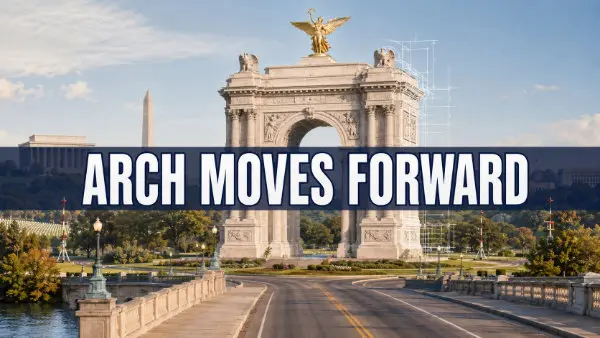
President Donald Trump’s proposed 250-foot United States Triumphal Arch has moved beyond the conceptual stage, but questions involving cost, legal authority and its effect on Washington’s historic landscape mean construction is not yet assured.
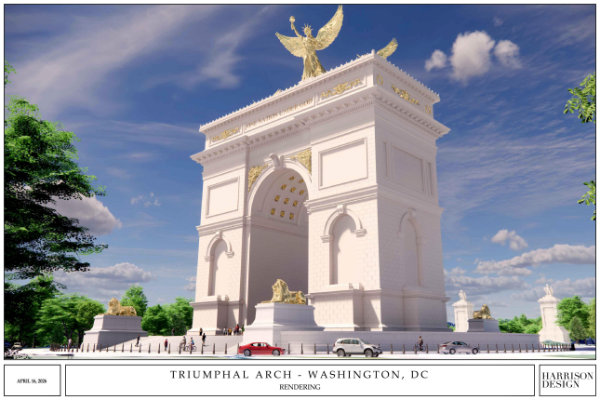
The monument is proposed for Memorial Circle, between Arlington National Cemetery and Arlington Memorial Bridge. Trump has promoted it as a national gateway commemorating 250 years of American independence.
Current plans call for a reinforced-concrete structure covered in granite and crowned by a large winged figure and two eagles. The main structure would stand approximately 166 feet, with the statues bringing its total height to about 250 feet. Inside would be five levels containing exhibit space, five elevators, six stairways and a public observation deck. A café and gift shop are also under consideration.
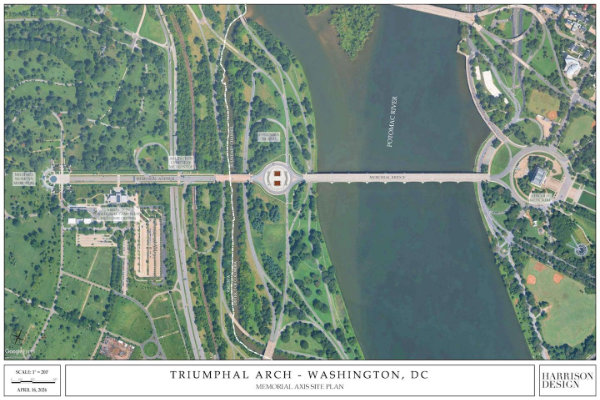
The U.S. Commission of Fine Arts approved the design in May. On July 9, the National Capital Planning Commission voted 8-1 to grant preliminary approval to the site and building plans. Final consideration could come as early as September, although approval is not guaranteed.
The National Park Service subsequently determined that the project would adversely affect 37 historic properties or their protected settings. The agency said the arch’s size and location would change important views involving the Lincoln Memorial, Arlington National Cemetery, Arlington House, the Kennedy gravesite, the National Mall, the Washington Monument and other landmarks.
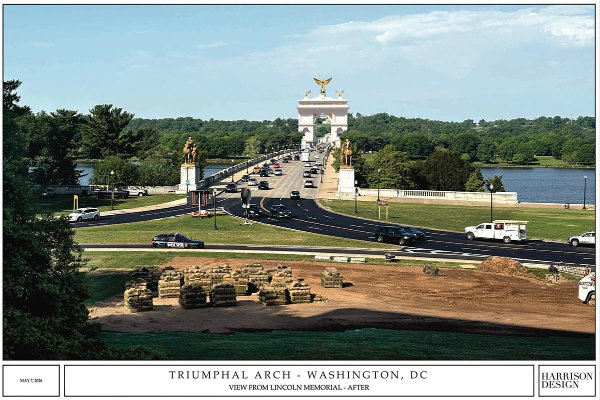
That finding does not automatically stop the project. It requires federal officials to continue consultations and develop measures intended to reduce or mitigate the effects.
The financial picture remains uncertain. The White House has not released an official construction budget. Published outside estimates generally range from approximately $100 million to $250 million, but those figures should not be treated as a final government estimate.
At least $15 million in federal funding has reportedly been reserved for the project through a National Endowment for the Humanities spending plan—$2 million in special-initiative money and $13 million in matching funds. Trump previously suggested that private donations, including possible surplus money from the White House ballroom project, could help finance the arch. Administration officials have since indicated that both public and private funding may be used.
Future operating expenses are also unknown. An observation deck, elevators, security screening, lighting, utilities, exhibits and landscaping would create continuing staffing and maintenance costs. No official estimate for those long-term expenses has been released.
If all remaining approvals are obtained, the earliest plausible construction start would be late 2026 or sometime in 2027. The Park Service’s preliminary schedule anticipates two to three years of construction, potentially operating in two 10-hour shifts each day. Under that timetable, completion would most likely occur between 2029 and 2030.
The schedule could change substantially. Veterans and preservation advocates have sued to block the project, arguing that federal law requires congressional authorization. The administration maintains that it has separate legal authority to proceed.
For now, the United States Triumphal Arch remains an advanced proposal—not a fully approved, fully funded or active construction project.
 Max Liebermann
 -
-
Arts & Culture
Washington DC
Triumphal Arch
-
365 views -
0 Comments -
0 Likes -
0 Reviews
-
-
Arts & Culture
Washington DC
Triumphal Arch
-
365 views -
0 Comments -
0 Likes -
0 Reviews





 Loading ...


