Pressure on Kyiv
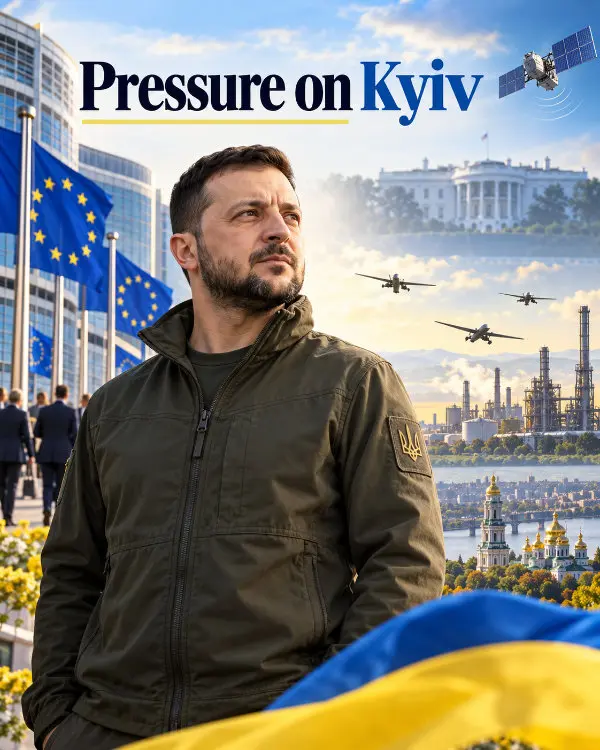
The widening rupture between President Donald Trump and Ukrainian President Volodymyr Zelensky has moved well beyond diplomatic disagreement. Washington is now putting direct pressure on Kyiv over how Ukraine fights Russia, while Trump is speaking about Vladimir Putin in markedly more accommodating terms than he uses for the leader of the country Russia invaded.
In an interview with Newsmax on Thursday, Oct. 15, Trump said he found Zelensky more difficult to negotiate with than Putin and accused the Ukrainian president of resisting efforts to end the war.
“I find Zelenskyy to be more difficult to deal with than Putin,” Trump said. He added that he was “not a big fan of Zelensky.”
The president also condemned Ukraine’s renewed attacks on Russian oil refineries, calling them a “disgrace” and arguing that they were contributing to higher global fuel prices.
Ukraine sees those refineries very differently. Oil production, refining and exports provide revenue to the Russian economy and help sustain Moscow’s war effort. Kyiv resumed attacks after accusing Russia of continuing missile and drone strikes against Ukrainian power facilities despite efforts to establish an energy ceasefire.
Trump’s argument that Ukrainian refinery attacks are driving the energy-price surge is also incomplete. The much larger force behind recent price increases has been the U.S.-Israeli war with Iran and the severe disruption of shipping through the Strait of Hormuz.
The dispute became considerably more serious with revelations involving Starshield, the military version of SpaceX’s Starlink satellite network.
According to U.S. and Western officials familiar with the matter, an instruction to restrict Starshield service for the Ukrainian military originated inside the White House. The restrictions interfered with Ukrainian drones used both for battlefield operations and for intercepting incoming Russian Shahed drones.
There is an important distinction: it has not been established that Trump personally issued the order. Officials have not identified who inside the White House made the decision, and a senior U.S. official denied that the president personally requested it.
Still, the timing has alarmed Kyiv and European governments because the restriction came as Washington was demanding that Ukraine stop striking Russian refineries.
It also follows Trump’s controversial agreement with Putin to permit renewed Russian diesel exports. The administration argues that additional Russian fuel could help stabilize global prices. Critics in Ukraine, Europe and the United States counter that easing restrictions gives Moscow additional revenue without first requiring Putin to end attacks or make significant concessions.
That raises an increasingly unavoidable question: Why does Trump appear so much more comfortable dealing with Putin than Zelensky?
For years, Trump has emphasized personal relationships with powerful leaders and portrayed diplomacy as a transaction between individual dealmakers. He has repeatedly said the United States should seek better relations with Moscow, questioned the cost of traditional alliances, complained about U.S. spending on Ukraine and argued that ending wars sometimes requires accepting difficult territorial or political compromises.
Putin fits that negotiating model better than Zelensky. The Russian president controls his government tightly and can bargain with relatively few domestic political constraints. Zelensky, by contrast, is defending a country that has been invaded and is being asked to surrender military options, territory or leverage. What Trump may regard as stubbornness, Ukrainians regard as national survival.
Trump has not always sided with Moscow. His administration has imposed sanctions on Russia, and he has periodically threatened Putin with serious consequences. But when negotiations stall, Trump has repeatedly directed unusually sharp public criticism toward Kyiv while speaking more cautiously about Moscow.
The result increasingly favors Putin strategically, whether or not that is Trump’s intention. Pressure on Zelensky to halt refinery attacks, restrictions affecting battlefield technology and efforts to ease Russian energy constraints all reduce pressure on Moscow while increasing it on Kyiv.
That imbalance is why European governments are worried.
At an EU summit in Brussels, European leaders rallied around Zelensky as Ukraine sought additional air-defense, energy and financial support. The divide is becoming clearer: Europe argues that Putin must face greater pressure before serious negotiations can succeed, while Trump increasingly appears to believe that pressure on Zelensky may produce a settlement faster.
For Ukraine, the distinction is existential. A peace agreement negotiated under heavy pressure may stop the shooting. But if Moscow is allowed to keep the benefits of invasion without credible guarantees against another attack, Kyiv fears it may simply exchange today’s war for tomorrow’s.
 News Staff
 -
-
Business
Rift Kyiv -US
Ukraine-Russia
-
96 views -
0 Comments -
0 Likes -
0 Reviews
-
-
Business
Rift Kyiv -US
Ukraine-Russia
-
96 views -
0 Comments -
0 Likes -
0 Reviews





 Loading ...


