 News Staff
 -
3 hours ago -
CBS
ABC
MS NOW and Politico
NBC and Fox News joined CNN
Stop TV coverage
-
58 views -
0 Comments -
0 Likes -
0 Reviews
-
3 hours ago -
CBS
ABC
MS NOW and Politico
NBC and Fox News joined CNN
Stop TV coverage
-
58 views -
0 Comments -
0 Likes -
0 Reviews
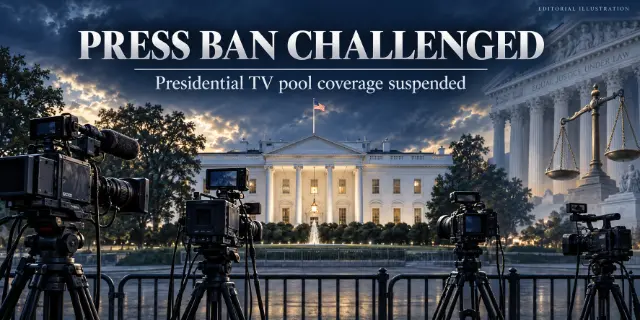
Press Ban Reaches Court
WASHINGTON — The television networks that normally take turns putting a camera in front of the president have stopped providing shared coverage of his events. ABC, CBS, NBC and Fox News joined CNN in suspending presidential TV pool coverage Monday, September 21, as CNN, MS NOW and Politico challenged their exclusion from the White House in federal court.
The distinction matters: the networks have not announced that they will stop reporting on Donald Trump. Their action concerns the rotating camera crews that record presidential appearances and distribute footage to other news organizations. CNN was scheduled to handle Monday’s assignment, including Trump’s trip to New York for the United Nations General Assembly. The other networks declined to replace it after the White House blocked its participation.
“No administration should restrict a news organization because it objects to its reporting,” the five networks said in a joint statement. Fox News’ participation makes this a collective response across competing newsrooms with different audiences and editorial approaches.
Trump announced the exclusions Friday, September 18. Reporters were denied entry Saturday after their credentials were invalidated. The president accused the outlets of publishing false and unfavorable coverage.
The administration defended its position Monday in a statement describing White House access as a privilege. Trump separately maintained that his action targeted what he called “fake news,” rather than press freedom. Those are the administration’s justifications; they do not establish that the exclusions are constitutional.
The three organizations filed one joint lawsuit, accompanied by a request for a temporary restraining order. The defendants include Trump, White House chief of staff Susie Wiles, communications director Steven Cheung and Secret Service Director Sean Curran. Three correspondents—CNN’s Betsy Klein, MS NOW’s Akayla Gardner and Politico’s Cheyenne Haslett—also joined as plaintiffs.
Their case raises two central constitutional claims: that the government retaliated against protected reporting in violation of the First Amendment, and that revoking established credentials without adequate procedures violated the Fifth Amendment’s guarantee of due process. They seek immediate restoration of access while the litigation proceeds.
U.S. District Judge Timothy J. Kelly, appointed by Trump, is handling the case. A hearing on the emergency request is scheduled for Wednesday, September 23. An emergency order would address access during the dispute; it would not itself represent a final resolution of every constitutional question.
The legal background is more specific than an unrestricted right to enter the White House. In Sherrill v. Knight, a federal appeals court ruled in 1977 that established White House press access could not be denied arbitrarily. It required notice of the reasons for denial, an opportunity to respond and a written decision. Security restrictions remain legitimate, but presidential dissatisfaction with coverage presents a different constitutional question.
Access disputes also have produced different results depending on the location involved. In the Associated Press case, an appeals court allowed restrictions on access to the Oval Office, Air Force One and other restricted presidential spaces while an appeal proceeded. That dispute underscores why a sweeping exclusion from White House grounds raises questions beyond admission to a particular meeting.
For the public, the immediate consequence is a disruption to a shared source of independently gathered presidential footage. The broader issue before the court is whether officials may withdraw established reporting access because they object to a newsroom’s coverage—a decision with consequences for how Americans learn what their government is doing.

Queue

Desert Local News delivers sharp, fact-checked coverage from the Coachella Valley to the world — local stories, business, entertainment, opinion, global headlines, and the unexpected moments that keep things interesting.

 Loading ...
