DLNews Staff
Not His House: Judge Halts White House Ballroom Plan
Washington – In a moment that reads more like constitutional theater than construction news, a federal judge has drawn a firm line around one of America’s most symbolic addresses: the White House does not belong to any president.
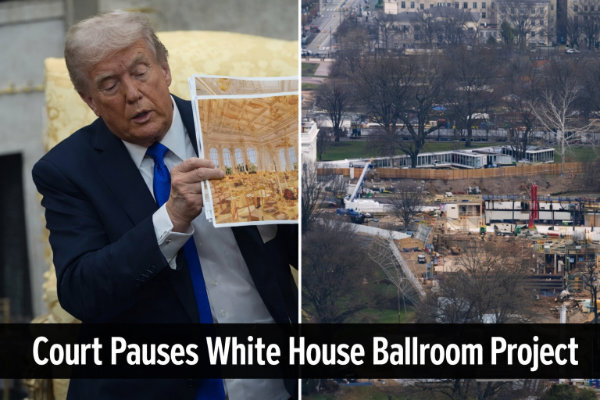
A proposed mega ballroom project tied to Donald Trump has been temporarily stopped, after U.S. District Judge Richard Leon issued an order halting construction amid a growing legal challenge. At the heart of the dispute is not just architecture—but authority.
The project, described as an expansive 8,360-square-meter addition, was pitched as a modern solution to long-standing space limitations for large-scale events. Supporters argued it would eliminate the need for temporary structures and enhance security and functionality. The estimated $400 million cost, according to officials, would be covered by private donors.
But critics, led by the National Trust for Historic Preservation, raised a more fundamental concern: whether such a transformation of the White House grounds could legally proceed without Congressional approval. Their argument rests on longstanding preservation laws and the principle that major structural changes to historic federal property require oversight beyond the executive branch.
Judge Leon’s ruling did not settle the final outcome—but it delivered a powerful reminder of constitutional boundaries. In his order, he emphasized that the president serves as a caretaker of the White House, not its owner. The phrase resonated immediately: a sitting president may reside there, govern from there, and host the world there—but ultimately, the house belongs to the American people.
The controversy also touches on the East Wing, a historic component of the White House complex dating back to the early 20th century and expanded during the era of Franklin D. Roosevelt. Preservation advocates argue that any demolition or significant alteration of such structures must follow strict federal guidelines, including Congressional involvement.
The administration has defended the project as a lawful modernization effort, backed by internal approvals and advisory commissions. However, critics note that oversight bodies tied to the project were composed largely of presidential appointees—raising questions about independence.
For now, construction is paused, and the matter heads toward further legal review. The outcome will likely hinge not on design or funding, but on a deeper question embedded in American governance: where executive ambition meets the rule of law.
In the end, the ruling underscores a principle as old as the republic itself—no matter who holds the office, the White House remains a public trust, not a personal legacy project.
 News Staff
 -
-
Arts & Culture
Whitehouse Ballroom
Washington DC
the National Trust for Historic Preservation
U.S. District Judge Richard Leon
-
331 views -
0 Comments -
0 Likes -
0 Reviews
-
-
Arts & Culture
Whitehouse Ballroom
Washington DC
the National Trust for Historic Preservation
U.S. District Judge Richard Leon
-
331 views -
0 Comments -
0 Likes -
0 Reviews