Must We Kill Everything We Can?
The Trump administration wants to open two protected national monuments to hunting. But with millions of acres already available to hunters, a more troubling question deserves an answer: When did protecting wildlife become less important than finding another place to shoot it?
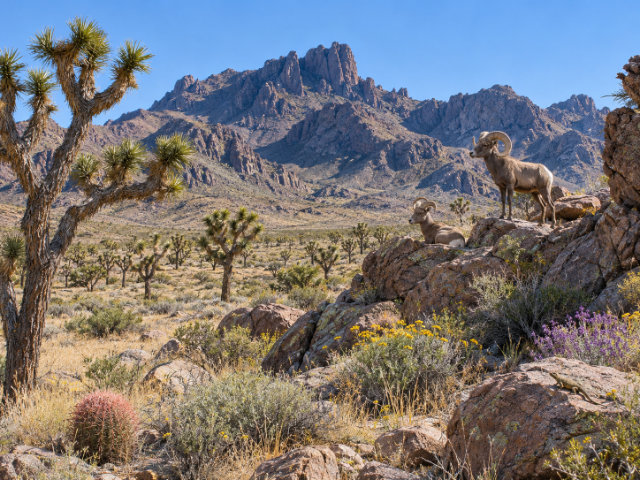
WASHINGTON — Somewhere in California's Mojave Desert, a bighorn sheep navigates a rocky mountainside, searching for vegetation and water. It has survived scorching temperatures, predators, drought and the everyday struggle of living in one of America's harshest environments.
What it cannot understand is a government proposal that could make its protected home another hunting ground.
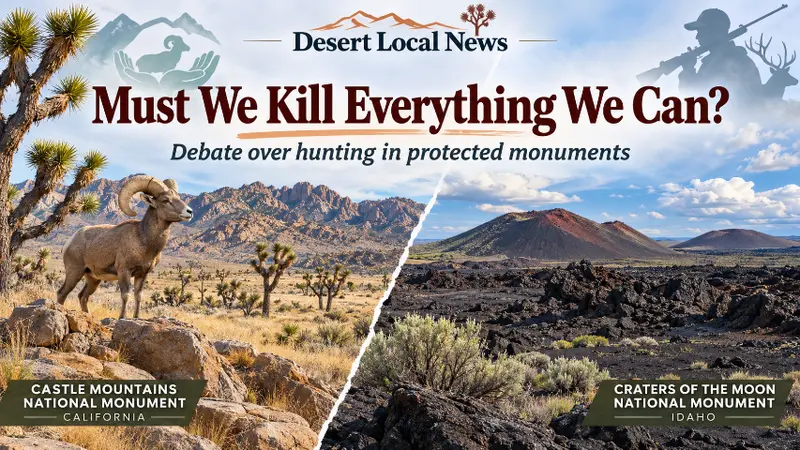
The Trump administration is proposing to permit hunting in California's Castle Mountains National Monument and Idaho's Craters of the Moon National Monument. The National Park Service published the proposed regulations on November 16, following a September executive order to expand hunting opportunities.
Conservation groups are challenging the administration's legal authority. But the controversy raises something more fundamental than federal regulations.
Why must we kill wildlife for sport in places specifically set aside to protect nature?
There was a time when hunting meant survival. Families depended on wild game to feed themselves. Indigenous peoples developed hunting traditions intimately connected to food, culture and the natural environment. Some Americans, including rural and subsistence communities, still rely heavily on harvested wildlife.
That deserves respect.
But necessity and recreation are not the same thing.
According to the U.S. Fish and Wildlife Service, approximately 14.4 million Americans participated in hunting in 2022. The agency does not establish how many hunted because they otherwise could not obtain adequate food. It would be misleading to characterize all hunters as trophy hunters, just as it would be misleading to describe recreational hunting as essential to national food security.
Millions of responsible hunters eat the animals they harvest. Some contribute substantially to conservation funding. Regulated hunting can also help wildlife managers address specific population problems.
Those are legitimate arguments. But they do not establish a biological necessity for hunting inside these particular monuments.
Indeed, the National Park Service acknowledges that hunting is already permitted across more than one million acres of surrounding Park Service land near Castle Mountains.
How much more territory is necessary?
And where does the expansion stop?
A rifle is not a level playing field
Modern hunting is often defended as a test of skill, patience and respect for nature.
Certainly, successful hunting requires knowledge and discipline. But sophisticated rifles, optical sights and other modern equipment have changed the relationship between hunter and animal.
A wild creature relies on instinct, hearing, smell and the ability to escape. Its human pursuer may possess equipment capable of killing from considerable distances.
That is not an equal contest. Nor has nature ever promised one.
The more important ethical question is whether an unequal contest should be deliberately arranged for human enjoyment in a federally protected wildlife habitat.
An animal does not recognize property boundaries, hunting seasons or executive orders. It simply attempts to survive.
And surely survival is a sufficiently demanding occupation without turning a designated sanctuary into additional recreational hunting territory.
Conservation is more than collecting hunting fees
Supporters correctly point out that hunters help finance wildlife conservation through license purchases and federal excise taxes.
That contribution matters.
But Americans also support conservation through taxes, donations, scientific research, habitat restoration, wildlife photography and tourism.
The Fish and Wildlife Service's 2022 survey found that more than 148 million Americans participated in wildlife watching, compared with approximately 14 million who hunted. Wildlife watching also generated substantially greater spending.
The public's relationship with wildlife is plainly not limited to harvesting it.
Nor should the economic contributions of hunters become an automatic justification for expanding hunting into additional protected areas.
Wildlife management should begin with ecological evidence. If a species is overpopulated, damaging habitat or creating documented environmental problems, science can help determine appropriate interventions.
But where is the evidence that hunting is necessary to restore ecological balance inside Castle Mountains or the original Craters of the Moon monument?
The administration's proposal emphasizes recreational access and state wildlife authority. It does not establish that either monument requires recreational hunting to control an excessive wildlife population.
What does protected actually mean?
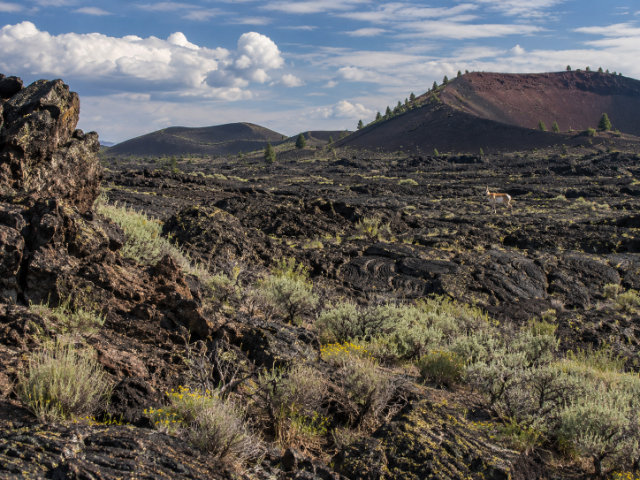
Castle Mountains was designated a national monument in 2016. Craters of the Moon first received federal monument protection in 1924.
These designations reflect a national decision to preserve distinctive landscapes, ecological systems and natural heritage.
National monuments are not all identical, and hunting is permitted in some protected federal areas. But the original Craters of the Moon monument and Castle Mountains have remained closed to hunting under existing Park Service rules.
Conservationists argue that changing those protections requires congressional authorization. The administration maintains that its regulatory authority permits the proposed changes. The legality remains contested, not judicially settled.
The proposal would also retain state hunting restrictions, federal endangered-species protections and certain safety limitations. It would not establish an unrestricted right to shoot every animal.
Nevertheless, the underlying policy question remains.
If an animal cannot find refuge inside an area designated for conservation, what precisely are we conserving?
The responsibility that comes with power
Humans possess extraordinary power over wildlife.
We build highways through migration corridors, develop natural habitats, divert water, introduce pollutants and alter ecosystems. Wildlife must continually adapt to decisions it had no part in making.
Our technological superiority creates a responsibility that deserves more public attention: stewardship.
Being stewards of the natural world means recognizing that we can do something without automatically concluding that we should.
There are legitimate places for regulated hunting. There are situations where wildlife management requires population control. And there are Americans whose relationship with hunting involves genuine food needs and longstanding cultural traditions.
But preserving protected landscapes serves an equally legitimate public purpose.
The administration has not yet demonstrated why expanding hunting into these two monuments is necessary, particularly when extensive neighboring lands already offer the activity.
Americans have until December 16 to comment on the proposal.
Before any regulation is finalized, the public deserves more than assurances about hunting traditions and additional recreational opportunities.
It deserves a convincing scientific justification, a sound legal foundation and a meaningful explanation of how wildlife protection will be preserved.
And perhaps one final question:
Must every wild animal be considered potential game simply because we possess the means to kill it?
A nation capable of sending spacecraft beyond our solar system should also be capable of leaving some of its wildlife in peace.
 Max Liebermann
 -
-
Recreation
protected national monuments to hunting
California's Castle Mountains National Monument
Idaho's Craters of the Moon National Monument
-
65 views -
0 Comments -
0 Likes -
0 Reviews






 Loading ...


