JTFMax:
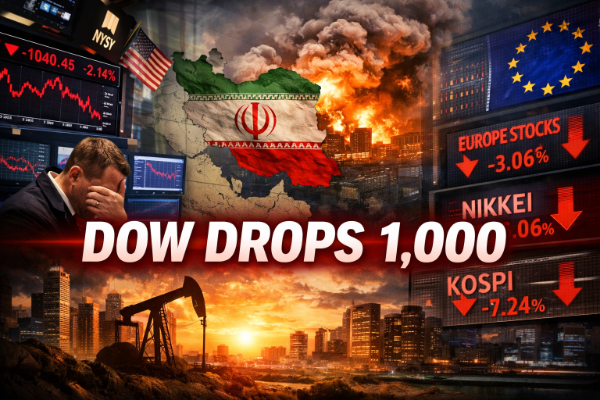
Market Shock: Dow Drops 1,000 — Valley Impact Ahead
Global markets were jolted Tuesday as fears of a prolonged conflict with Iran sent investors rushing for cover. The Dow Jones Industrial Average plunged more than 1,000 points shortly after the opening bell, a drop of roughly 2.1%. The S&P 500 slid about 1.8%, while the Nasdaq fell nearly 2%. Wall Street’s volatility index, the VIX — often referred to as the market’s “fear gauge” — surged more than 20%, hitting its highest level in three months.
The anxiety was not confined to the United States. European and Asian markets also posted sharp losses. Europe’s Stoxx 600 fell more than 3%, Japan’s Nikkei dropped over 3%, and South Korea’s Kospi tumbled more than 7% in one of its worst trading days this year. Investors are reacting to concerns that a widening Middle East conflict could disrupt oil supplies, reignite inflation pressures, and slow global growth.
For the Coachella Valley, the immediate concern is energy. If crude oil prices remain elevated, gasoline prices in Riverside County could climb again, squeezing household budgets and increasing transportation costs for local businesses. Higher fuel prices typically ripple through delivery services, construction, hospitality operations, and agriculture — all key pillars of the regional economy.
Tourism, the Valley’s economic engine, could also feel indirect effects. If airfare and travel costs rise due to higher fuel prices, visitor numbers may soften. Large-scale events and seasonal tourism often depend on discretionary spending, which can tighten when markets turn volatile, and consumer confidence weakens.
However, it is important to note that market drops tied to geopolitical shocks can be sharp but temporary. The Coachella Valley’s diversified mix of tourism, healthcare, real estate, and retail has historically shown resilience during short-term global turbulence.
For now, local businesses and consumers alike will be watching oil prices, inflation data, and Federal Reserve signals closely. If the conflict remains contained, markets may stabilize. But if tensions escalate, higher costs and slower spending could become the new economic reality — even in the desert.
 JustTheFacts Max
 -
-
Business
S&P 500
Nasdaq Composite
Dow Jones
STOXX 600
Nikkei
Global Markets
Wallstreet
Kospi
-
317 views -
0 Comments -
0 Likes -
0 Reviews
-
-
Business
S&P 500
Nasdaq Composite
Dow Jones
STOXX 600
Nikkei
Global Markets
Wallstreet
Kospi
-
317 views -
0 Comments -
0 Likes -
0 Reviews