DLN World at War
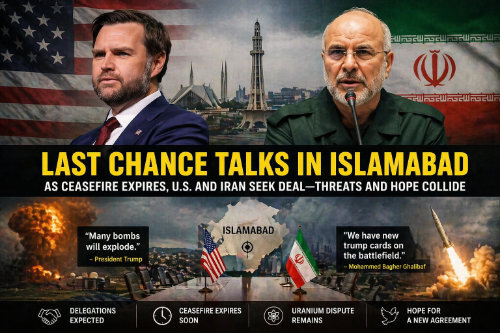
LAST CHANCE TALKS IN ISLAMABAD
Shortly before the expiration of the ceasefire, Iran sent negotiators to talks with Vance.
The speaker of parliament of the Iranian regime, Mohammed Bagher Ghalibaf (64), is leading the negotiations with the USA
Washington/Tehran/Islamabad – Will the Iran war soon continue as it did two weeks ago? One day before the expiration of the two-week ceasefire agreement between the US and Iran, both countries have confirmed the arrival of delegations for a second round of talks on the Iran war in the Pakistani capital Islamabad, according to information from mediators.
As the AP news agency was informed, US Vice President JD Vance and Iranian Parliament Speaker Mohammed Bagher Ghalibaf as heads of delegation are expected to arrive in the Pakistani capital on Wednesday. This has been confirmed to the intermediary states, among which Pakistan plays a leading role.
Neither the US nor Iran have publicly confirmed the timing of the talks. Until the end, it was not even clear whether the Iranian regime was really sending negotiators. Iranian state television had previously reported that no delegation from the country had traveled to Islamabad so far. "Neither a main nor a secondary delegation" has so far set off for Pakistan as a negotiating country, it said. Reports of a delegation leaving Tehran for talks with US representatives in Islamabad are false. However, a considerable tightening of security precautions has been observed in Islamabad since Sunday at the latest.
Threats on both sides
Both sides also again covered each other with threats. US President Donald Trump said that without new negotiations, the ceasefire would end "Wednesday evening, US time". The exact time is unclear.
Iran's chief negotiator, Parliament Speaker Mohammed Bagher Ghalibaf, had previously stated on the online service X that Tehran would have "new trump cards on the battlefield" at its disposal in the event of a resumption of the Iran war. The Islamic Republic has been preparing "in the past two weeks" to "play it out". Ghalibaf also reiterated that Tehran does not accept "negotiations in the shadow of threats".
US President Trump called an extension of the ceasefire "highly unlikely". Previously, Washington had said that a US delegation led by Vice President JD Vance should arrive in Islamabad "soon". For the time being, however, there was no official confirmation of this.
US Vice President JD Vance (41) will lead the negotiations on the American side from Wednesday
Points of contention remain
Trump again threatened Iran with massive attacks. If the US demands are not met by the end of the ceasefire, "many bombs will explode," he told PBS. In addition, the US would only lift the blockade of Iranian ports in the event of a "deal" with Iran, Trump wrote in online services.
A little more than a week ago, negotiations between the US and Iran in Pakistan had been inconclusive. Both sides accused each other, among other things, of violating the ceasefire, which came into force on April 8. In addition, the blockade of the Strait of Hormuz is a controversial issue.
Another point of contention between Washington and Tehran is uranium enrichment, which Iran does not want to give up. Trump announced a lengthy process to get uranium out of Iran. The US attacks on Iranian nuclear facilities in June last year had resulted in a "complete and total annihilation" of the nuclear facilities, he said. "Therefore, it will be a long and difficult process to dig it up again," he added, referring to uranium. Trump wants to bring it to the US after a peace agreement with Iran.
However, Iran had denied an alleged willingness to hand over its enriched uranium as part of the negotiations with the US on Friday. "Iran's enriched uranium is not being transferred anywhere," said Iranian Foreign Ministry spokesman Esmail Bakaei.
 News Staff
 -
-
Arts & Culture
JD Vance
Washington/Tehran/Islamabad
Mohammed Bagher Ghalibaf
war or peace
-
313 views -
0 Comments -
0 Likes -
0 Reviews
-
-
Arts & Culture
JD Vance
Washington/Tehran/Islamabad
Mohammed Bagher Ghalibaf
war or peace
-
313 views -
0 Comments -
0 Likes -
0 Reviews