Himalayan Flood Horror
A quiet Wednesday morning in the Himalayas became a nightmare within seconds.
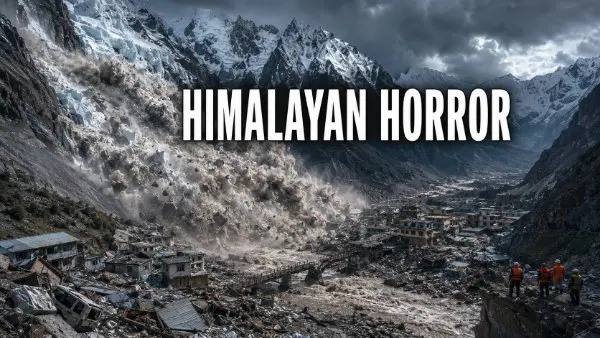
On August 26, a massive section of glacier near Nepal’s Langtang Lirung peak broke away at an elevation of about 5,127 meters. Ice and rock crashed roughly 1,400 meters onto the valley floor, generating a high-speed avalanche that swept into the Lhende Khola river system near the Nepal-China border.
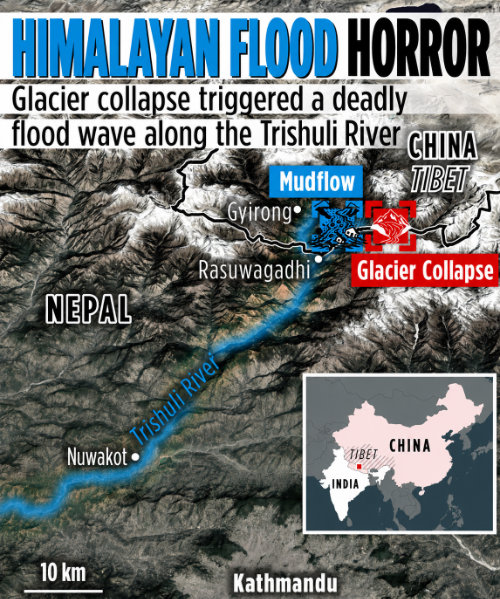
The collapsing mass gathered glacial sediment, boulders and water as it descended, transforming into a thick, fast-moving wall of mud and debris. Chinese scientists estimated that the initial debris flow traveled at approximately 50 meters per second—about 112 mph—and continued for more than 20 kilometers before producing catastrophic flooding farther downstream.
By late Thursday, authorities reported at least 359 people dead across Nepal and China’s Tibet region, with nearly 1,000 others still missing. At least 540 of those unaccounted for were foreign travelers. The figures remained preliminary and could change substantially as isolated communities are reached and duplicate missing-person reports are reconciled.
The disaster struck without the prolonged rainfall that might have warned communities below. The torrent rushed through the Lhende Khola and into the Bhote Koshi and Trishuli river systems, burying buildings, sweeping away vehicles and destroying roads, bridges, power projects and communications equipment.
Timure, Syapru Besi and the Rasuwagadhi-Gyirong border area were among the hardest-hit locations. Video from Gyirong showed people running as a towering brown wave engulfed the border complex in seconds. A later aerial survey revealed that virtually every building at the crossing—including customs and immigration facilities—had been destroyed.
Although some reports claimed the disaster traveled nearly 170 kilometers, that distance has not been independently verified. Satellite analysis confirmed that floodwaters altered river channels and caused destruction more than 100 kilometers downstream—still an extraordinary reach for a disaster that began high in the mountains.
The valley was crowded despite its remote location. The border crossing is an important trade route between Nepal and Tibet, while the surrounding roads carry workers, truck drivers, trekkers and pilgrims traveling toward Mount Kailash and Lake Manasarovar, sacred destinations for Hindus and Buddhists. Many people were staying in hotels, waiting at immigration facilities or traveling in organized tour groups when the flood struck.
Americans were among those caught in the disaster. Nepalese authorities listed 63 U.S. citizens as missing on the Nepal side, while broader estimates indicated that approximately 90 Americans could remain unaccounted for across Nepal and Tibet. Three Americans had been rescued, and no American deaths or serious injuries had been officially confirmed as of Thursday.
Rescuers now face destroyed roads, deep mud and the danger of another catastrophe. Debris from the avalanche has blocked waterways and created two unstable lakes. Authorities warned that either natural dam could fail, sending another powerful surge into communities already shattered by one of the Himalayas’ deadliest modern disasters.
 News Staff
 -
-
Other
Himalayas
Nepal’s Langtang Lirung peak
Nepal and China’s Tibet region
Mud- tsunami
-
300 views -
0 Comments -
0 Likes -
0 Reviews
-
-
Other
Himalayas
Nepal’s Langtang Lirung peak
Nepal and China’s Tibet region
Mud- tsunami
-
300 views -
0 Comments -
0 Likes -
0 Reviews






 Loading ...


