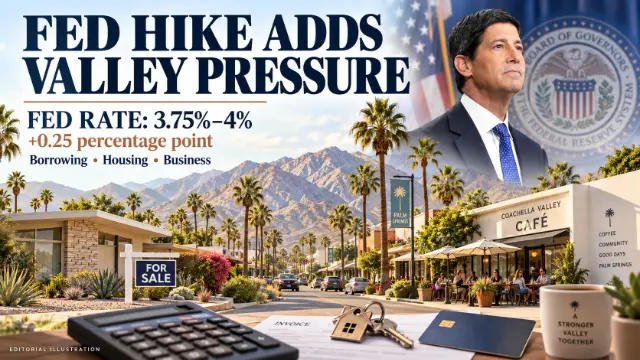
Fed Hike Adds Valley Pressure
For a Coachella Valley restaurant financing equipment or a family shopping for a home, Washington’s latest interest-rate decision could make the next purchase harder to afford.
The Federal Reserve raised its benchmark rate on Wednesday, September 16, by a quarter percentage point to 3.75%–4%, its first increase since July 2023. The unanimous 12–0 decision marked a renewed effort to restrain inflation while the economy continued expanding.
Chairman Kevin Warsh delivered a direct explanation: “The plain fact is that inflation is too high, and has been for too long.”
Warsh described an economy strong enough to withstand tighter policy, with a resilient labor market but insufficient progress against inflation. Summer price readings had not demonstrated meaningful improvement in underlying trends, he said.
The outlook suggests borrowing relief could remain elusive. Officials’ median projections indicated another quarter-point increase by December, bringing the target range to 4%–4.25%, with the same year-end level projected for 2027. Those estimates reflect individual assessments, not a binding schedule.
Officials projected inflation, measured by the Personal Consumption Expenditures price index, at 3.7% this year and 2.3% next year, reaching 2% in 2029. Their median growth forecast remained positive: 2.3% in 2026 and 2.4% in 2027.
For Greater Palm Springs, the potential pressure runs through business financing, housing and visitor spending.
Major banks raised their prime lending rates to 7% from 6.75% following the announcement. Businesses with loans tied to prime could face higher interest expenses as their contracts reset, leaving less money for equipment, inventory or expansion. Credit-card borrowers may also see higher costs.
As an illustration, a quarter-point increase passed through fully to a constant $100,000 loan balance adds approximately $250 in annual interest.
Homebuyers face a different mechanism. Mortgage rates respond to bond markets and inflation expectations, rather than automatically matching each Fed adjustment. Freddie Mac’s September 10 survey put the national average 30-year fixed mortgage at 6.76%. Existing fixed-rate borrowers retain their contracted interest rate.
For Valley hotels, restaurants and retailers, the risk is that visitors facing higher debt payments and travel expenses trim discretionary purchases. That could mean shorter stays or fewer meals out; these are possible consequences, not documented local changes following Wednesday’s decision.
Energy adds another complication. The Congressional Budget Office reported on September 15 that disrupted oil and natural-gas shipments through the Strait of Hormuz had raised energy prices. Higher petroleum costs also feed into shipping and the prices of other goods.
The Valley’s near-term outlook, therefore, depends on both inflation and demand. Easing energy costs and continued employment growth could help sustain spending despite expensive credit. Persistent inflation could require further tightening, increasing pressure on borrowers and business margins.
For local employers, the practical indicators will be bookings, customer spending and financing costs. A national rate increase alone cannot establish how much Valley hiring, tourism, or home sales will change.
 Max Liebermann
 -
-
Business
Federal Reserve raised its benchmark
3.75%–4%
Kevin Warsh
-
75 views -
0 Comments -
0 Likes -
0 Reviews
-
-
Business
Federal Reserve raised its benchmark
3.75%–4%
Kevin Warsh
-
75 views -
0 Comments -
0 Likes -
0 Reviews






 Loading ...


