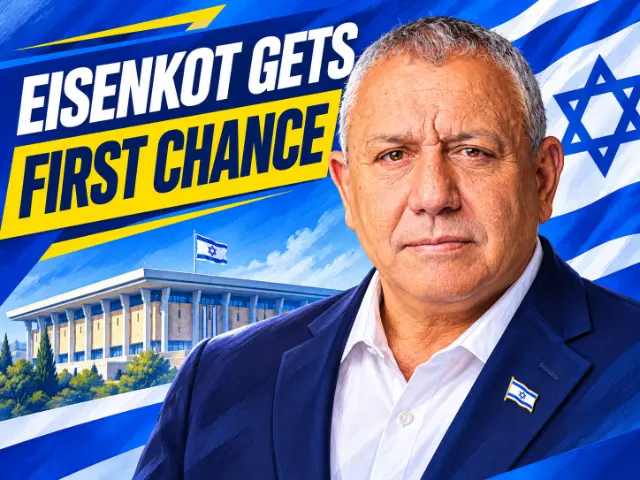
Eisenkot Gets First Chance
JERUSALEM — Benjamin Netanyahu’s party won the most seats. Gadi Eisenkot will get the first opportunity to assemble a government. That distinction now puts Israel’s political future in the hands of a former military commander facing a task that battlefield experience alone cannot resolve: persuading deeply divided parties to govern together.
President Isaac Herzog announced Saturday, November 7, that he would entrust Eisenkot, leader of the centrist Yashar party, with forming Israel’s next government. The formal handover is scheduled for Sunday, November 8, at 5 p.m. at the President’s Residence in Jerusalem. The decision gives Netanyahu’s principal challenger an opening to replace him, but does not itself remove the prime minister from office.
The October 27 election produced a parliament with plenty of political opposition and no ready-made governing majority. Netanyahu’s Likud secured 27 of the Knesset’s 120 seats, ahead of Yashar’s 21. But Likud and its allied parties together won only 53 seats, below the 61 that constitute an outright parliamentary majority. Eisenkot’s competing bloc won 48, while two Arab-led lists captured the remaining 19.
During Herzog’s consultations, factions representing 67 lawmakers recommended Eisenkot, compared with 46 recommending Netanyahu. Another seven-member faction made no recommendation. Those endorsements gave Eisenkot the advantage, although they did not amount to signed coalition agreements.
Herzog had already identified the central problem when he concluded his initial consultations Thursday: “mutual vetoes between the blocs and within the blocs themselves.” His responsibility, he explained, was to determine who could actually form a government, rather than simply count recommendations.
For Eisenkot, the hardest negotiations may involve parties that have already backed his nomination.
The Arab-led Joint List won 11 seats and Ra’am eight. Their combined support brought his recommendations to 67, but recommending a candidate to the president does not commit a party to joining his Cabinet or supporting its program. One possible arrangement would be a minority coalition relying on outside parliamentary support from Arab-led parties.
Avigdor Liberman, whose Yisrael Beytenu party holds seven seats in Eisenkot’s bloc, has opposed precisely that arrangement. His party’s backing for Eisenkot therefore comes with a substantial obstacle: it supports changing the prime minister while rejecting one of the clearest available routes to doing so.
Another route would bring ultra-Orthodox parties away from Netanyahu. Here, military service becomes a central dividing line. Eisenkot has advocated a broader obligation to serve, while ultra-Orthodox parties have sought exemptions protecting religious students from conscription. For families carrying the burden of military and reserve duty, that disagreement reaches well beyond coalition arithmetic.
A third possibility is a broad government including Likud.
Netanyahu called Saturday for national unity. Yashar responded that Likud would be welcome only if it broke with its extremist allies, accepted Eisenkot’s governing principles and agreed to serve under Eisenkot as prime minister. That leaves the leadership question at the center of any potential agreement.
Eisenkot, who served as Israel’s military chief from 2015 to 2019, would bring decades of security experience to the office. His family also suffered a personal wartime loss: his son Gal, 25, was killed fighting in Gaza in December 2023.
Once formally assigned the task, Eisenkot will have 28 days to form a government. Herzog may grant additional time totaling no more than 14 days. If Eisenkot fails, the president can turn to another willing lawmaker, potentially Netanyahu; that second attempt would have a 28-day limit without an extension. Further failure could ultimately send Israelis back to the polls.
One legal distinction matters: 61 seats provide an outright majority, but a new government does not necessarily need 61 affirmative votes to take office. It must win the Knesset’s confidence vote, and a minority government can succeed if supporting votes outnumber opposing votes. Abstentions could therefore become consequential.
Netanyahu remains prime minister while the formation process unfolds. Eisenkot now has the first opportunity to replace him—and the responsibility to turn endorsements into an agreement strong enough to govern.
 Max Liebermann
 -
-
Other
Benjamin Netanyahu
Israel election
Gadi Eisenkot
-
73 views -
0 Comments -
0 Likes -
0 Reviews






 Loading ...


