 News Staff
 -
Thu at 7:36 PM -
NASA
SpaceX
Cape Canaveral Space Force Station.
International Space Station
-
79 views -
0 Comments -
0 Likes -
0 Reviews
-
Thu at 7:36 PM -
NASA
SpaceX
Cape Canaveral Space Force Station.
International Space Station
-
79 views -
0 Comments -
0 Likes -
0 Reviews
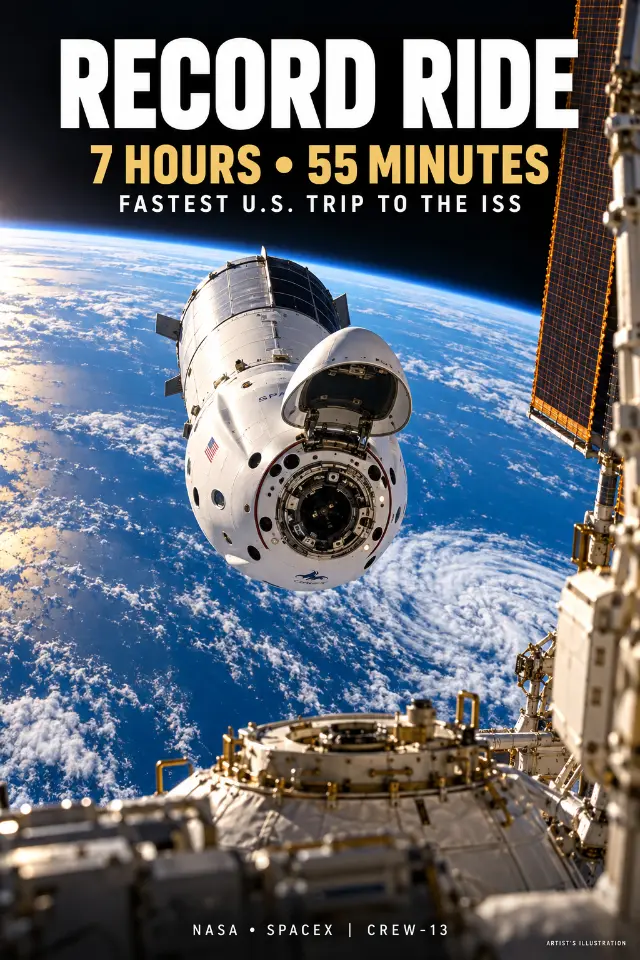
Dragon’s Record Ride
Florida in the morning. The International Space Station by evening. Four astronauts turned that extraordinary itinerary into an American spaceflight milestone Thursday, Oct. 1, reaching the orbiting laboratory just seven hours and 55 minutes after launch.
SpaceX’s Crew Dragon docked at 7:05 p.m. EDT, completing the fastest launch-to-docking journey by a U.S. spacecraft in the station’s history, NASA confirmed. For NASA, SpaceX and their international partners, Crew-13 delivered an accomplishment worth celebrating—and a fresh team ready to work.
The Falcon 9 rocket lifted off at 11:10 a.m. EDT from Space Launch Complex 40 at Cape Canaveral Space Force Station. For West Coast viewers, that meant an 8:10 a.m. launch and a 4:05 p.m. docking: a remarkable journey completed within an ordinary workday.
Leading the mission was NASA commander Jessica Watkins, joined by NASA pilot Luke Delaney, Canadian Space Agency astronaut Joshua Kutryk and Roscosmos cosmonaut Sergey Teteryatnikov, both mission specialists. Their spacecraft, Grace, previously carried the private Axiom Mission 4 crew in 2025.
“Thanks for an amazing ride,” Watkins radioed after liftoff. She also made history as the first Black woman to command a crew traveling to orbit.
Watkins brought experience from 170 days in space during the 2022 Crew-4 mission. A geologist with a doctorate from UCLA, she previously worked on the science team for NASA’s Curiosity Mars rover. Delaney brought a background in naval aviation and experimental flight testing. For Delaney, Kutryk and Teteryatnikov, this was their first spaceflight.
Kutryk, a Royal Canadian Air Force colonel, test pilot and engineer, became the first Canadian Space Agency astronaut to participate in NASA’s Commercial Crew Program. His assignment calls for approximately six months aboard the station.
The quick arrival followed weeks of patient preparation. A propulsion-system leak disrupted the earlier launch schedule, prompting technicians to replace an oxidizer valve before proceeding with final preparations.
Clouds threatened Thursday’s countdown, but conditions permitted liftoff. The station’s favorable position at launch enabled the unusually short pursuit. Crew-12’s February journey, by comparison, took about 34 hours.
After Dragon connected to the forward port of the station’s Harmony module, crews completed checks before opening the hatch at 9:19 p.m. EDT. The newcomers then entered the station, temporarily bringing its population to 11.
A brief handover will prepare Crew-12 astronauts Jessica Meir, Jack Hathaway, Sophie Adenot and Andrey Fedyaev for departure. NASA said their return sequence would begin no earlier than Monday, Oct. 5, with the schedule subject to operational readiness and weather conditions.
For the arriving astronauts, the record journey opens a much longer scientific assignment. Research includes blood circulation and clotting in weightlessness, astronaut vision and performance, and ways to protect crews on future missions.
Other investigations involve stem-cell-derived tissues relevant to heart disease and Parkinson’s disease, crop production and medical monitoring. The potential benefits extend from safer exploration to a better understanding of human health on Earth.
Kutryk also has a personal milestone ahead: his wife, Heather, is expecting their third child in late November. The Canadian Space Agency has promised support for the family while he is away.
Seven hours and 55 minutes secured Crew-13’s place in the record books. The months ahead will give that arrival its lasting value.

Queue

Desert Local News delivers sharp, fact-checked coverage from the Coachella Valley to the world — local stories, business, entertainment, opinion, global headlines, and the unexpected moments that keep things interesting.

 Loading ...
