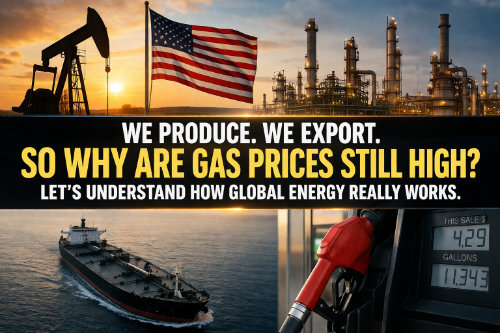
America First, Global Prices: Why U.S. Gas Still Rises in an Oil-Rich Nation
It’s a question many Americans are asking again: If the United States produces vast amounts of oil—and even exports it—why aren’t gas prices consistently low at home? In an era often framed by “America First” energy policies, the answer is less about supply alone and more about how modern global markets actually work.
The United States is indeed one of the world’s largest oil producers. Thanks to shale production, domestic output has surged over the past decade, at times making the U.S. a net exporter of petroleum products. On paper, that sounds like energy independence—and to a degree, it is. But independence does not mean isolation.
Oil is priced on a global market, not a national one. Whether a barrel is pumped in Texas, Saudi Arabia, or offshore Brazil, its price is influenced by worldwide supply and demand. Benchmarks like Brent crude and West Texas Intermediate (WTI) reflect global conditions—wars, shipping disruptions, production cuts, and economic growth across continents. When tensions rise in places like the Middle East or shipping lanes such as the Strait of Hormuz are threatened, prices increase everywhere—including at U.S. gas pumps.
There’s also a structural reality: not all oil is created equal. U.S. refineries are designed to process specific types of crude. Much of America’s shale oil is lighter, while many refineries are optimized for heavier imports. This creates a two-way trade—exporting some oil while importing other types better suited for refining. It may sound counterintuitive, but it’s economically efficient.
Another key factor is refining capacity. Gasoline prices depend not just on crude oil, but on how much refining can be done—and at what cost. Limited refinery expansion, maintenance shutdowns, and environmental regulations can all tighten supply, pushing prices higher even when crude is plentiful.
Then there’s the issue of market incentives. Oil companies operate in a global capitalist system. If producers can sell oil abroad at higher prices, they will. Restricting exports might lower domestic prices temporarily, but it could also discourage production, disrupt trade relationships, and lead to unintended long-term consequences.
Finally, taxes, distribution costs, and regional regulations play a role. States like California, for example, often see higher prices due to stricter fuel standards and limited pipeline infrastructure.
So, could the U.S. keep gas prices artificially low? Technically, yes—through heavy intervention. But doing so would mean stepping away from the global market system that also benefits American producers and exporters.
The bottom line: America’s oil strength is real, but it operates within a global economy. Energy independence doesn’t shield consumers from global price swings—it simply gives the country more leverage within them. Understanding that distinction is key to making sense of the numbers on the pump—and the policies behind them.
 News Staff
 -
-
Business
America First Energy
US-largest-oil-producers
high-prices
-
464 views -
0 Comments -
0 Likes -
0 Reviews
-
-
Business
America First Energy
US-largest-oil-producers
high-prices
-
464 views -
0 Comments -
0 Likes -
0 Reviews