-
456 Views 0 Comments 0 Likes
El-Sayed’s Michigan Upset
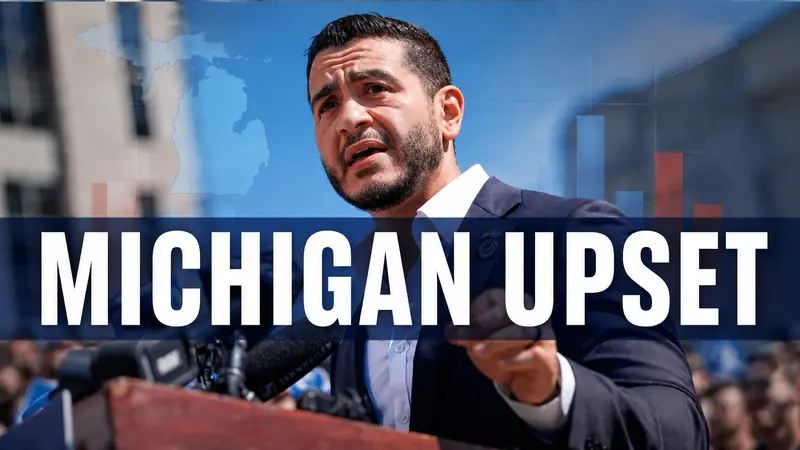
Abdul El-Sayed’s narrow victory in Michigan’s Democratic U.S. Senate primary represents a remarkable political comeback—and an important test of whether progressive candidates can compete statewide in closely divided territory.
The 41-year-old former public health official defeated U.S. Rep. Haley Stevens by fewer than 15,000 votes, a margin of just under one percentage point, with more than 1.5 million ballots counted. He will face former Republican congressman Mike Rogers in November in a contest that could help determine control of the Senate.
El-Sayed’s victory was unexpected because he has never held elected office and had been largely absent from electoral politics since losing Michigan’s 2018 Democratic gubernatorial primary to Gretchen Whitmer by more than 20 percentage points.
During the years that followed, El-Sayed wrote books, hosted a podcast and appeared regularly on television, YouTube and other digital platforms. Those activities allowed him to remain part of the political conversation while gradually building an audience outside traditional party organizations.
His opportunity arrived when Democratic Sen. Gary Peters announced that he would not seek reelection. El-Sayed entered the Senate race in April 2025 with four staff members and little institutional support. Stevens, by contrast, was an established member of Congress backed by prominent Democrats, including Peters, Gov. Gretchen Whitmer and Senate Democratic Leader Chuck Schumer.
El-Sayed compensated by building an extensive field operation. According to his campaign, he visited 110 Michigan cities, conducted more than 500 events and assembled a volunteer network of about 12,000 people. He also pursued interviews across traditional news organizations, podcasts and social media platforms, enabling him to reach voters who might not follow conventional political coverage.
The contest changed significantly when state Sen. Mallory McMorrow suspended her campaign on July 5. Although her name remained on the ballot, her withdrawal effectively transformed the primary into a two-candidate race and gave El-Sayed an opportunity to consolidate progressive voters.
Money became another defining issue. Outside organizations supporting Stevens spent more than $60 million, including more than $30 million from the American Israel Public Affairs Committee and affiliated groups. Rather than being overwhelmed by that spending, El-Sayed used it to reinforce his argument that wealthy organizations exercise too much influence over elections.
His platform included Medicare for All, campaign-finance reform, higher taxes on billionaire wealth and ending U.S. military assistance to Israel. Those positions earned endorsements from progressive leaders, including Sen. Bernie Sanders and Rep. Alexandria Ocasio-Cortez, while also giving Republicans clear lines of attack.
The result should not automatically be interpreted as a wholesale rejection of moderate Democrats. Nearly half of primary voters supported Stevens, who argued that her legislative experience and history of winning competitive elections made her the stronger general-election candidate. McMorrow received approximately 4% despite having withdrawn.
Stevens conceded on Wednesday and endorsed El-Sayed, while McMorrow also offered her support. That early show of unity is important because El-Sayed cannot win the general election with progressive voters alone. He will need to retain Stevens’ supporters while attracting independents and less ideological voters concerned primarily with prices, employment, health care and public safety.
Rogers presents a formidable challenge. He served in Congress from 2001 through 2014 and narrowly lost Michigan’s 2024 Senate election to Democrat Elissa Slotkin. The Republican Senate campaign organization has already reserved $45 million in Michigan advertising, and additional outside spending is expected before November.
El-Sayed’s primary victory proves that a heavily outspent candidate can prevail through persistent organizing, disciplined messaging and broad use of modern media. It does not yet prove that the same strategy can win a battleground-state general election.
That question will be answered in November.
Michigan’s Democratic U.S. Senate primary Abdul El-Sayed U.S. Rep. Haley Stevens

Queue

Desert Local News delivers sharp, fact-checked coverage from the Coachella Valley to the world — local stories, business, entertainment, opinion, global headlines, and the unexpected moments that keep things interesting.