News Staff December 12, 2025
6.1K views 0 Comments 0 Likes
DLNews Family & Home
As countries test new rules and parents raise concerns, societies grapple with how to balance protection, access, and free expression.
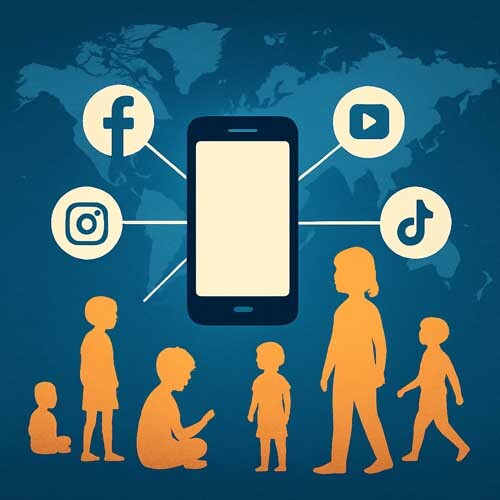
The debate over children and social media has reached a turning point. What once sounded like a niche concern of anxious parents or tech skeptics has become a serious, global conversation about childhood, technology, and responsibility. Australia’s decision to restrict social media access for children under 16 did not settle the issue—it sharpened it. And while the United States has taken a different legal path, the questions facing society are strikingly similar.
At its core, this debate is not about liking or disliking technology. Social media has connected families, amplified voices, fueled creativity, and provided young people with tools that did not exist a generation ago. For many teens, these platforms are not distractions but social infrastructure—places where friendships are maintained, identities explored, and communities found. Any serious discussion must acknowledge that reality. A society cannot regulate something responsibly if it pretends it has no value.
At the same time, mounting evidence suggests that social media was not designed with children’s developing brains as the primary concern. Platforms are engineered to maximize engagement, reward repetition, and hold attention. For adults, this can be draining. For children, it can be overwhelming. Parents, pediatricians, and educators increasingly report higher levels of anxiety, sleep disruption, social comparison, and emotional distress among young users. These concerns are not theoretical. They are observed daily in classrooms, homes, and clinics.
In the United States, the response has been cautious, fragmented, and shaped by constitutional limits. Unlike Australia, American law treats social media largely as protected speech, making outright bans legally fragile. As a result, U.S. efforts have focused on alternative solutions: requiring parental consent, redesigning platforms for minors, limiting data collection, and pushing companies toward age verification. Courts have slowed or blocked many of these laws, but the persistence of new proposals signals something important—the concern itself is not going away.
What has changed most noticeably is who is driving the conversation. It is no longer dominated by politicians or technology critics. Parents from across the social and ideological spectrum are asking similar questions: At what age is constant digital exposure healthy? How much responsibility should families carry alone? And what obligations do companies have when their products shape childhood at scale?
Technology companies argue, not without reason, that enforcement is difficult and that age verification raises privacy risks. Free speech advocates warn that poorly designed restrictions could limit expression or exclude vulnerable voices. These concerns deserve serious consideration. History shows that rushed regulation can create unintended consequences, especially when applied to fast-moving technologies.
Yet doing nothing also has consequences. Leaving families to navigate powerful digital systems entirely on their own assumes equal time, knowledge, and resources—an assumption that rarely holds true. It also ignores the reality that children encounter social media not as isolated individuals, but as members of peer networks where opting out can carry social costs.
Australia’s approach has drawn global attention precisely because it shifts responsibility away from families and onto platforms themselves. Whether that model succeeds remains to be seen. It may prove effective, ineffective, or somewhere in between. What matters for the broader conversation is not whether one country has found the perfect answer, but whether societies are willing to test solutions thoughtfully, adjust them transparently, and remain open to evidence rather than ideology.
The real challenge is not choosing between freedom and protection, or technology and childhood. It is finding a balance that reflects both. A healthy society can acknowledge that social media is neither harmless nor inherently dangerous, neither savior nor villain. It can accept that children deserve safeguards without treating them as incapable, and that innovation can continue without ignoring responsibility.
Perhaps the most constructive outcome of this moment is not a single law, but a shared willingness to pause and ask better questions. What does a healthy digital childhood look like? Who should bear which responsibilities? And how do we design systems that grow with our values, rather than outpace them?
The answers will not be simple. But the fact that so many parents, educators, technologists, and policymakers are finally asking the questions together may be a meaningful start.

Queue

Desert Local News delivers sharp, fact-checked coverage from the Coachella Valley to the world — local stories, business, entertainment, opinion, global headlines, and the unexpected moments that keep things interesting.



Comments