THE PARCHMENT AND THE PUNDIT: Why Your Grocery Bill is Secretly the Fault of 13th-Century French Peasants
History doesn’t repeat itself, but it sure does love to copy and paste.
If you’ve recently glanced at a gas pump or a grocery receipt and felt an overwhelming urge to weep into your steering wheel, you’re not alone. But if you listen closely to the televised explanation for why your checking account is currently on life support, you’ll notice a beautiful, timeless rhythm. Depending on who is standing at the podium, inflation is never the fault of the person holding the gavel. Instead, it is an enigmatic, supernatural conspiracy orchestrated by greedy supply chains, opposing backbenchers, uncooperative weather, or a malevolent butterfly fluttering maliciously over South America.
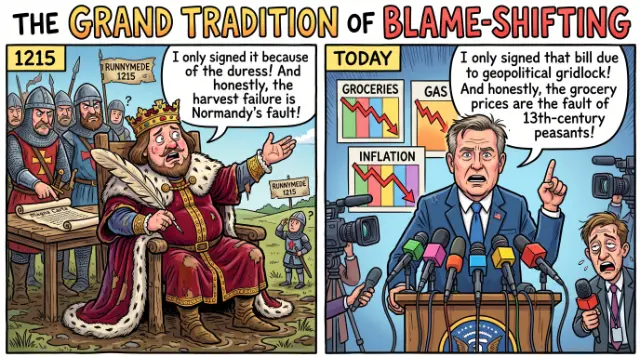
To truly appreciate this masterclass in blame-shifting, we don't need a panel of economists with dry-erase boards. We just need to take a quick trip back to Runnymede, England, in June of 1215, to visit the undisputed godfather of the political pivot: King John.
Historically, King John is remembered for two things: surrendering massive chunks of English territory to France, and dying of dysentery after eating way too many peaches. But before his unglamorous digestive exit, John pioneered a public relations playbook that modern politicians have spent eight centuries refining. When he lost Normandy, he didn't hold a town hall to admit he had mismanaged the royal defense budget. Instead, he glared at his barons and explained that the defeat was entirely their fault for not fighting hard enough—and that the real villain was an obstinate French peasant who refused to be taxed efficiently.
Eight hundred years later, when diesel and egg prices hit orbit, the logic remains delightfully medieval: success is the inevitable result of my visionary leadership, while failure is an act of God, a rogue market anomaly, or an ambush by my enemies.
Naturally, maintaining this illusion requires a very flexible relationship with the rule of law. John was an ardent champion of the Divine Right of Kings, a medieval legal doctrine translating roughly to: "Because the crown fits my head, I can seize your livestock, bypass the courts, and rewrite the rules whenever I wake up cranky."Today, we don’t call it divine right; we call it an emergency decree or an executive workaround. Whenever a modern leader collides with the inconvenient wall of institutional gridlock, they rarely marvel at the beauty of constitutional checks and balances. Instead, they draft sweeping edicts overnight or launch a press blitz attacking the personal integrity of whatever magistrate dared to read the fine print. John would have admired the instinct, even if he found the endless press briefings terribly inefficient compared to a heavy wax seal and an iron dungeon.
Nowhere is the family resemblance stronger, however, than in the time-honored tradition of the campaign "take-back."
Surrounded in a muddy meadow by heavily armed, profoundly irritated barons, King John signed the Magna Carta, guaranteeing due process and swearing on holy relics that he wouldn't levy taxes without widespread consent. It was the ultimate populist campaign pledge. The ink had scarcely dried before John fired off an urgent, breathless dispatch to the Pope, explaining that he had signed the contract under duress and that it should be formally incinerated. The Pope obligingly tore it to shreds, the promises evaporated like mist over the Thames, and England plunged straight into civil war.
It is a performance any modern coalition might envy when reviewing its manifesto the Monday morning after an election. The promise to curb the cost of living? Unforeseen global headwinds have regrettably intervened. The ironclad pledge on fiscal restraint? A bad deal forced upon us by the previous administration. The solemn commitment to institutional transparency? Well, the opposition started it.
The bitter punchline of Runnymede is that the Magna Carta was an absolute catastrophe in 1215. It didn't rescue England because a monarch underwent a miraculous moral conversion; it survived because generations of everyday citizens were pigheaded enough to keep shoving the parchment back into the king’s face until the ink finally stuck.
The barons didn't waste their breath praying for an enlightened, selfless sovereign. They simply built a remarkably heavy fence around the disastrously flawed one they had. Today, our tools have graduated from sheepskin to ballots and court dockets, but the civic job description hasn't shifted an inch: reminding the people in power that they are public servants, not anointed rulers.
And if their memory happens to slip, we can always remind them how the story ended for King John. It involved a sodden English marsh and a deeply regrettable bushel of peaches.
 Max Liebermann
 -
-
Business -
King John
Magna Carta
High Grocery Prices
Fuel Cost
Global Inflation
Supply Chain Shortages
-
63 views -
0 Comments -
0 Likes -
0 Reviews
-
-
Business -
King John
Magna Carta
High Grocery Prices
Fuel Cost
Global Inflation
Supply Chain Shortages
-
63 views -
0 Comments -
0 Likes -
0 Reviews