Election Observers Left Uninvited
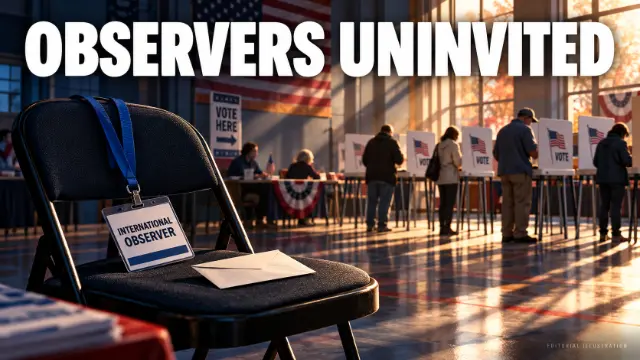
An invitation that has accompanied every U.S. federal election since 2002 is missing this year. The Organization for Security and Co-operation in Europe said September 23 that the United States had declined to invite its observers for the 2026 congressional midterms, breaking with more than two decades of cooperation.
The decision raises two distinct questions: whether Washington can withhold an international invitation, and whether a president can prohibit lawful election observation across the country. Those actions involve different powers.
The OSCE said it had observed 12 U.S. federal elections, including six midterms. Parliamentary Assembly President Pere Joan Pons called the decision “a significant departure from an established democratic practice.” Maria Telalian, director of its Office for Democratic Institutions and Human Rights, expressed regret at losing the opportunity to continue that work.
The announcement does not identify a personal directive from President Donald Trump, provide an executive order or establish a nationwide ban on foreign observers. It documents the absence of an invitation from the United States. Describing it as a confirmed personal order from Trump would go beyond the statement’s evidence.
The international commitment is clear. Paragraph 8 of the 1990 Copenhagen Document commits participating countries, including the United States, to invite observers from other participating states and appropriate organizations to national elections. Observers, in turn, must refrain from interfering with electoral proceedings.
But the legal character of that promise matters. The OSCE explains that its human-dimension commitments are politically binding rather than legally enforceable. The Copenhagen Document therefore does not, by itself, give observers a right they can enforce in a U.S. courtroom to compel an invitation. Departing from that commitment is different from violating a domestic statute or an enforceable treaty obligation.
Federal invitations have traditionally come through the State Department. Given the president’s authority to conduct diplomacy, the stronger legal reading is that the administration generally can decide whether to extend one, absent a separate legal requirement. That conclusion concerns diplomatic participation; presidential foreign-affairs powers remain subject to constitutional limits and applicable legislation.
Authority inside polling places is a separate matter. Article I, Section 4 of the Constitution assigns regulation of congressional elections principally to the states, while allowing Congress to make or alter those rules. It does not give the president a general power to rewrite election procedures by decree. A nationwide presidential order overriding lawful observer access would therefore require an independent constitutional or statutory basis.
California illustrates the distinction. Its election regulations require uniform, nondiscriminatory access for qualifying international observers to stages of the election process open to the public, including ballot processing, counting and recounts. Observers must not interfere with voters or election workers. Withholding a federal invitation does not, by itself, repeal those protections.
Elsewhere, access depends on the jurisdiction’s laws. Election officials can enforce authorized restrictions and safeguards, but an international affiliation or federal invitation does not provide unrestricted access. Officials likewise cannot assume unlimited authority to exclude observers where applicable law protects their presence.
Why end the practice? Governments might cite sovereignty, distrust of an organization or diplomatic disagreements. Avoiding independent criticism is another possible motive. The OSCE announcement does not establish the administration’s reasoning, and none of those explanations should be presented as fact in this case.
For voters, the practical consequence is the loss of an established outside assessment. OSCE missions examine election rules and practices and publish findings and recommendations. Their absence does not itself establish fraud or invalidate an election, and it does not automatically eliminate domestic observation.
It does, however, remove one source of independent information—and leave the administration with an accountability question: What public interest is served by ending a practice that helped voters evaluate how their elections are conducted?
 \
\ 



Comments