Cracks in the Echo
JustTheFactsMax /Op-Ed
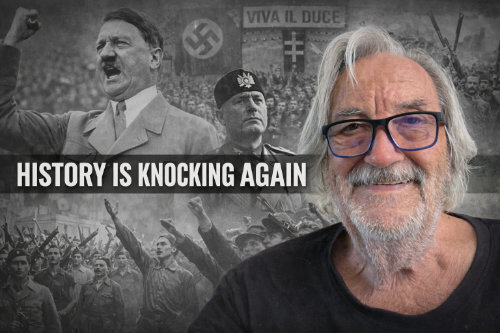
History rarely repeats itself in perfect symmetry—but it does rhyme, and lately, the chorus has grown uncomfortably familiar.
In 1926, a then-marginal political agitator named Adolf Hitler was rebuilding his movement after a failed coup. His message was simple, sharp, and emotionally charged: national pride, economic grievance, and a promise to restore lost greatness. Across Europe, similar currents stirred. In Italy, Benito Mussolini had already demonstrated how quickly democratic systems could bend under pressure from populist nationalism. Spain would soon follow its own turbulent path toward authoritarian rule.
We know how that chapter ended—catastrophically.
Fast forward to 2026, and the ingredients feel eerily recognizable, though the packaging is sleeker, faster, and amplified by technology. Inflation is again a persistent undercurrent. The divide between rich and poor has widened into something harder to ignore. Global wealth concentration is accelerating, with billionaires edging toward trillionaire status, while everyday households feel the squeeze of rising costs.
And then there’s the noise—instant, relentless, unavoidable. Unlike the 1920s, today’s world operates in real time. Satellite networks, social media platforms, and digital ecosystems mean that every speech, every misstep, every “tricky Dickey” maneuver is visible within seconds. The public is not just informed; it is saturated.
Yet awareness does not always translate into clarity.
Across continents, nationalist rhetoric has found fertile ground again—often fueled by economic frustration, cultural anxiety, and geopolitical tension. Wars simmer. Territorial disputes escalate. Religious and ideological divisions sharpen. None of this is new. What is new is the speed at which fear, anger, and misinformation can spread.
Still, history offers more than warnings—it offers patterns of resolution.
Authoritarian figures, no matter how dominant they appear in their moment, have a remarkably poor long-term track record. Power consolidated through division tends to fracture under pressure. The arc is rarely quick, never clean, but it bends. It always bends.
And here’s where the present diverges from the past in a meaningful way: people today are watching more closely. Elections—especially in major democracies—remain a pressure valve. Midterms, general elections, referendums—these are not just procedural events; they are signals of collective direction.
There is nothing inherently dangerous about loving one’s country. National pride, in its healthiest form, builds identity and cohesion. But history draws a hard line between pride and exclusion, between unity and isolation.
Because the world, inconveniently for extremists, is round.
Economies are intertwined. Resources are shared. Crises—whether climate, conflict, or financial—do not respect borders. The idea that any nation can thrive entirely alone is not just outdated; it is impractical.
And yet, the oldest disruptor remains unchanged: greed. Not ambition, not success—but the kind of unchecked accumulation that destabilizes systems and erodes trust. When wealth pools too tightly at the top, pressure builds below. History is quite clear on what happens next.
So, is history repeating itself?
Not exactly. But it is certainly clearing its throat.
The difference this time may come down to awareness—and response. People are not as in the dark as they once were. The signals are visible, the patterns recognizable. The question is whether that awareness translates into action before the rhyme becomes a refrain.
Because if history has proven anything, it’s this: no era of concentrated power, rising inequality, and aggressive nationalism has ever ended quietly.
And in the end—slowly, unevenly, but decisively—the people tend to win.
 \
\ 



Comments