 Max Liebermann
 -
Jul 29 -
FIFA President Gianni Infantino
FIFA Forward Enterprise
or FFE
-
157 views -
0 Comments -
0 Likes -
0 Reviews
-
Jul 29 -
FIFA President Gianni Infantino
FIFA Forward Enterprise
or FFE
-
157 views -
0 Comments -
0 Likes -
0 Reviews
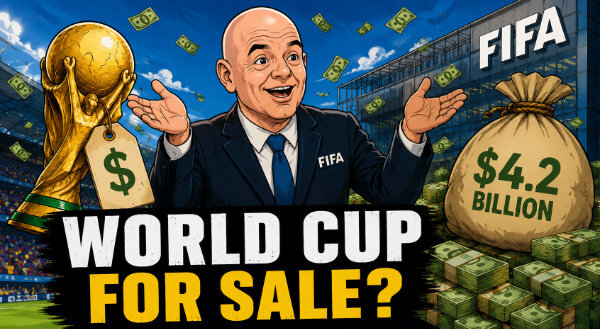
World Cup for Sale
FIFA President Gianni Infantino has broken his silence over a business proposal that could permanently change how the World Cup is financed, marketed and operated—and critics fear the world’s most popular sporting event is being moved closer to becoming an investment product.
At the center of the controversy is FIFA Forward Enterprise, or FFE, a proposed commercial subsidiary valued at approximately $20 billion. The new company would combine FIFA’s broadcasting, sponsorship, ticketing, licensing and tournament-delivery operations under one corporate roof. FIFA would then sell private investors a non-controlling stake of up to 20%, raising as much as $4.2 billion.
Infantino insists that FIFA is not simply selling the World Cup.
“FFE is first and foremost a proposal, an offer,” he said in a video released by FIFA. “It is part of a democratic process—a consultation process—and above all an opportunity, not an obligation.”
According to Infantino, the company would be established only if it receives support from a majority of FIFA’s 211 member associations and final approval from the FIFA Council. FIFA would retain majority ownership and exclusive authority over competition rules, tournament formats, match calendars and other sporting decisions.
On paper, FIFA would remain in control. The unanswered question is how much influence multibillion-dollar investors would eventually expect over the business behind the competitions.
FIFA argues that the deal would release money that could be invested in stadiums, training centers, women’s soccer, youth programs and national teams, particularly in smaller countries. Each member association could receive up to $40 million during the 2027-30 funding cycle—$20 million through FIFA Forward and an additional one-time payment of as much as $20 million through a new Fast Forward program.
“The growing economic value of football has so far only reached a small extent where it is most urgently needed,” Infantino said, presenting the arrangement as a way of sharing the World Cup’s wealth more widely.
But FIFA’s version of democracy comes with an expensive incentive and a deadline.
Infantino has given national federations until September 19 to decide whether they want access to the one-time $20 million offer. His letter told members that approval could unlock a development package worth more than $10 billion. Rejecting the proposal would leave them with FIFA’s previously planned, considerably smaller funding increase.
For wealthy soccer nations, the difference may be manageable. For small federations that depend heavily on FIFA money, turning down millions of dollars would be far more difficult. That has led critics to question whether the vote represents a free choice or financial pressure dressed as consultation.
UEFA responded with unusually blunt language, declaring that the proposal “crosses a line that football’s governing institutions should never cross.”
“The soul and governance of football are not assets to trade,” UEFA said. “None of us are the owners of football. It is not FIFA’s to sell.”
The criticism is not limited to Europe. CONCACAF, the Asian Football Confederation and the English Football Association said they were surprised that such an advanced proposal had become public before meaningful discussions with major soccer stakeholders
Joshua Kushner’s Thrive Capital is expected to serve as a leading investor, while JPMorgan is advising FIFA and would guide the investment process. Kushner is the younger brother of Jared Kushner, President Donald Trump’s son-in-law, adding a political dimension to a deal already facing questions about transparency and influence. There is no confirmed provision in the proposal requiring the World Cup or Club World Cup to be held more frequently. However, private investors buying into a $20 billion enterprise would logically expect growth and strong returns. That could create pressure for more matches, more participating teams, higher ticket prices, additional sponsorship opportunities and expanded tournaments.
Infantino attempted to reassure supporters.
“The fans remain at the heart of the most beautiful game in the world,” he said, promising that FIFA’s competitions and sporting authority would remain protected.
But supporters have heard similar promises before each tournament expansion, new sponsorship category and increase in ticket prices. The matches may still last 90 minutes and the field may remain the same size, but the institution surrounding the game could be fundamentally altered.
This is therefore about more than raising $4.2 billion. It is about whether part of the World Cup’s commercial future should be placed in the hands of private investors whose first obligation will not be to the supporters, the players or the traditions of the game—but to the value of their investment.
FIFA says the World Cup is not being sold. Its critics believe the first piece may already be on the negotiating table.


Desert Local News delivers sharp, fact-checked coverage from the Coachella Valley to the world — local stories, business, entertainment, opinion, global headlines, and the unexpected moments that keep things interesting.