U.S. Targets Iran’s Dollar Lifeline
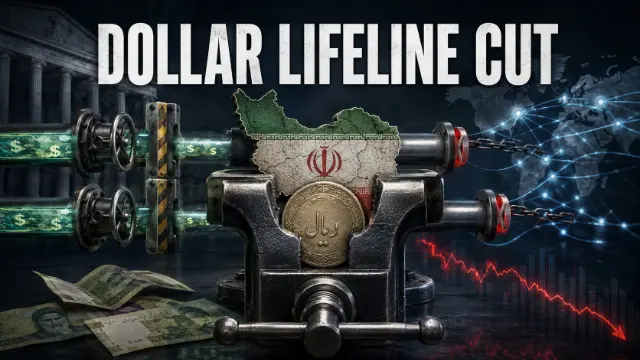
The United States has opened a new front in its campaign to isolate Iran economically, targeting a banking channel that Washington says helped Tehran move nearly $2 billion through the United Arab Emirates and gain access to U.S. dollars.
On August 28, the Treasury Department’s Financial Crimes Enforcement Network proposed cutting Banque Misr’s UAE operations off from correspondent accounts at American financial institutions. Such accounts allow foreign banks to clear dollar payments and participate in international transactions connected to the U.S. financial system.
Treasury estimates that Banque Misr UAE processed approximately $1.8 billion between January 2024 and June 2026 for 103 companies potentially connected to Iranian shadow-banking networks. According to Treasury, some of those companies operated as fronts for Iran’s Ministry of Defense and the Islamic Revolutionary Guard Corps or helped move money associated with sanctioned Iranian officials.
The proposed action does not immediately freeze Banque Misr’s assets or prohibit all its global operations. It remains subject to a 30-day public-comment period and applies only to the bank’s six UAE branches—not its headquarters in Cairo or operations elsewhere. Nevertheless, a final rule could make it considerably more difficult for the UAE branches to conduct dollar-denominated business, even indirectly through other foreign banks.
The Central Bank of Egypt confirmed that the proposed restriction is limited to Banque Misr’s UAE operations and said Egyptian authorities were communicating with Washington. Banque Misr had not publicly responded to the specific U.S. allegations at the time of the announcement.
In a related move, the Treasury’s Office of Foreign Assets Control sanctioned Reza Mohammad Taeedi, general manager of Iran’s Bank Melli branch in Dubai. It also sanctioned Kameng Trading Limited, a Hong Kong company accused of helping a previously sanctioned Iranian exchange house launder money and reach the international financial system.
The wider objective extends beyond these individual targets. By demonstrating that a foreign bank could lose access to dollar clearing because of suspected Iranian transactions, Washington is warning financial institutions worldwide that continuing to handle Iranian money could jeopardize their own access to the United States.
That threat could have a powerful chilling effect. Banks may reject even lawful Iran-related transactions rather than accept the compliance and sanctions risks. Iranian exporters could face greater difficulty receiving payments, while importers may struggle to obtain the dollars needed to purchase food, medicine, machinery and industrial components. Businesses could be forced to use longer, more expensive and less reliable payment routes.
The consequences could deepen Iran’s shortage of accessible foreign currency, put additional downward pressure on the rial and make imported goods more expensive. Although the sanctions are directed at government-linked networks, the resulting inflation and scarcity are likely to be felt most sharply by ordinary households.
Iran was already facing a severe economic downturn. The International Monetary Fund projects that its economy will contract by 5.4 percent in 2026, while consumer-price inflation averages 68.9 percent. The World Bank has reported that currency depreciation, sanctions and conflict have already contributed to rapidly rising prices, import difficulties and growing food-security risks.
The banking action alone will not shut down Iran’s economy. Tehran has spent decades developing alternative payment systems, front companies, informal money-transfer networks and trading relationships outside the West. But replacing a major dollar channel costs money, causes delays and exposes the next intermediary to possible sanctions.
The move, therefore, represents both a direct financial restriction and a warning to banks elsewhere: helping Iran evade sanctions may now carry the price of losing access to the world’s most important currency and financial market.
 News Staff
 -
-
Business
Iran Banking Channel sanction
US-Treasury
Banque Misr’s UAE
-
301 views -
0 Comments -
0 Likes -
0 Reviews
-
-
Business
Iran Banking Channel sanction
US-Treasury
Banque Misr’s UAE
-
301 views -
0 Comments -
0 Likes -
0 Reviews






 Loading ...


