DLN-War
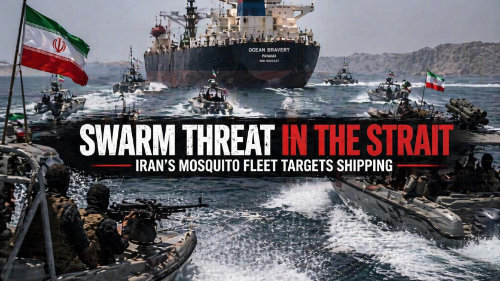
SWARM THREAT IN THE STRAIT
Tehran—They are fast, elusive, and terrifyingly effective. In the world’s most critical oil chokepoint, Iran’s so-called “Mosquito Fleet” has turned the Strait of Hormuz into a high-stakes maritime gamble—and the global economy is watching with clenched teeth.
This is not a conventional naval showdown. It is guerrilla warfare at sea. Instead of relying on large warships, Iran’s Islamic Revolutionary Guard Corps (IRGC) deploys swarms of small, high-speed attack boats—thousands of them by some military estimates—armed with machine guns, rockets, and, in some cases, guided weapons. Their tactic is brutally simple: overwhelm, intimidate, and vanish.
For civilian shipping, the danger is acute. Massive oil tankers and cargo vessels—slow, exposed, and largely defenseless—are no match for a coordinated swarm attack. Unlike naval destroyers, they lack both the speed and weaponry to respond. The result: a narrow corridor of water where every crossing now carries real risk.
The geography makes it worse. At its tightest point, the Strait of Hormuz is only about 21 miles (roughly 39 kilometers) wide, leaving little room to maneuver. That confined space dramatically shortens reaction times. A swarm of speedboats—some reportedly capable of speeds approaching 100+ mph (around 160–185 km/h)—can close in within minutes.
Even more concerning is how difficult these vessels are to detect and neutralize. Small radar signatures, coastal camouflage, and the ability to disperse quickly make them a nightmare for surveillance systems. Western defense analysts have long noted that these boats can operate from hidden inlets, island outposts, and hardened coastal facilities, launching in waves with minimal warning.
Iran’s broader strategy appears designed to exploit this asymmetry. While large portions of its traditional navy may be vulnerable in a direct confrontation, the “Mosquito Fleet” thrives in chaos. It’s cheap, flexible, and perfectly suited for harassment tactics in confined waters. Add in sea drones, naval mines, and mini-submarines, and the threat multiplies beneath and above the surface.
Recent incidents underscore the tension. International maritime monitors report multiple vessel attacks since hostilities escalated, including tankers struck while attempting passage. Each new encounter raises the stakes—not just for regional security, but for global energy markets that depend heavily on this narrow route.
Because here’s the bottom line: roughly a fifth of the world’s oil passes through the Strait of Hormuz. If that flow is disrupted, even briefly, the shockwaves hit gas prices, supply chains, and financial markets worldwide—fast.
And as this swarm strategy tightens its grip, one thing is clear: in the Strait of Hormuz, the smallest boats may now pose the biggest threat.
 News Staff
 -
-
World at War
Straits of Hormuz
Iran's Mosquito Fleet
speedboats
-
2K views -
0 Comments -
0 Likes -
0 Reviews
-
-
World at War
Straits of Hormuz
Iran's Mosquito Fleet
speedboats
-
2K views -
0 Comments -
0 Likes -
0 Reviews



 Loading ...


