DLN Staff
Pakistan Trip Scrapped: Iran Peace Talks Hit Another Wall
WASHINGTON/ISLAMABAD — President Trump has canceled a planned U.S. delegation trip to Pakistan, casting fresh doubt over already fragile peace efforts with Iran and signaling that Washington believes Tehran is either unwilling — or unable — to negotiate with one clear voice.
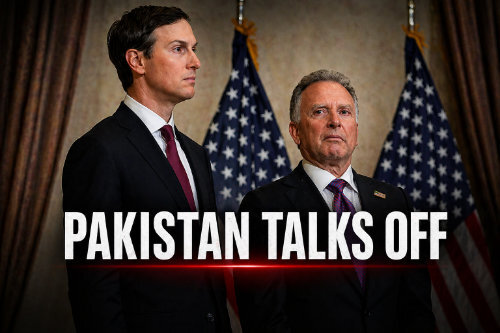
The canceled mission was expected to include U.S. special envoy Steve Witkoff and Jared Kushner, who were reportedly set to travel to Islamabad for another round of talks aimed at ending the Iran conflict. The move came after Iranian Foreign Minister Abbas Araghchi left Pakistan following meetings with Pakistani leaders, but without any visible breakthrough.
Trump later reiterated that the long travel time was a key reason for canceling the trip, saying future negotiations could be handled by phone instead of repeated long-haul missions. Speaking to reporters outside Air Force One in Florida before traveling back to Washington, D.C., Trump said: “We’re not going to spend 15 hours in airplanes all the time going back and forth to be giving a document that was not good enough, and so we’ll deal by telephone, and they can call us anytime they want.”
That comment sharpened the White House message: Washington is not breaking off diplomacy, but it is refusing to send senior envoys across the world for talks it views as unproductive. The phrase “document that was not good enough” also suggests the U.S. side was dissatisfied with what Iran or intermediaries had placed on the table.
The immediate reason appears to be a mix of logistics, frustration, and uncertainty inside Iran’s leadership. Trump repeated earlier claims that Iran’s leadership is divided, arguing that this confusion is complicating the talks. U.S. officials appear to believe Tehran has not produced a unified position on ending the conflict, while Iran has continued to resist direct talks under what it describes as excessive American pressure.
Pakistan has been trying to serve as a mediator, with Prime Minister Shehbaz Sharif and Pakistan’s military leadership meeting Iranian officials. Islamabad remains an important diplomatic bridge, especially because both sides may still need a neutral setting if the talks revive.
The status now is simple but dangerous: the talks are not dead, but they are stalled. The United States is signaling that Iran can call when it is ready. Iran is signaling that it will not be forced into a deal on American terms. Pakistan remains available, but the bridge has little value if neither side is ready to cross it.
The wider stakes are enormous. The conflict has rattled oil markets, raised concerns over shipping through the Strait of Hormuz, and left U.S. allies watching nervously. The longer diplomacy freezes, the greater the risk that a ceasefire becomes merely a pause between rounds of fighting.
For now, Trump’s message is blunt: Washington is not sending negotiators on 15-hour flights just to receive weak proposals and mixed signals. Iran’s message is equally sharp: it will talk, but not surrender. Between those two positions sits Pakistan, trying to mediate a war that could still spill far beyond the region.
 News Staff
 -
-
Business
WASHINGTON/ISLAMABAD
Pakistan talks off
-
1K views -
0 Comments -
0 Likes -
0 Reviews
-
-
Business
WASHINGTON/ISLAMABAD
Pakistan talks off
-
1K views -
0 Comments -
0 Likes -
0 Reviews