Hackers Hold the Master Key: Could Palm Springs Face a Global Web Blackout?
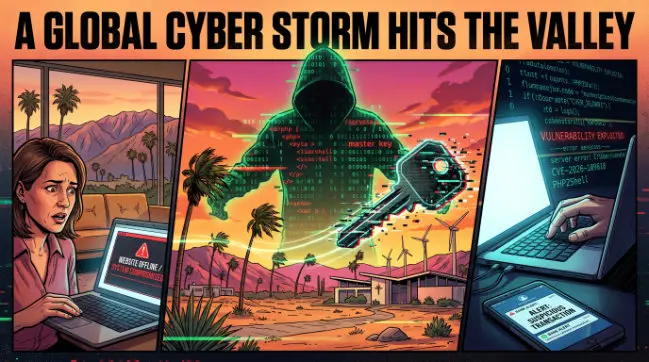
Imagine waking up to discover that the locks on seven out of every ten storefronts, hospitals, and city halls in the world suddenly stopped working, and burglars already have a copy of the master key. That is the exact nightmare unfolding across the internet right now. In Germany, major hospitals, police departments, and entire city governments just pulled the plug on their own websites in a frantic race to lock the digital doors before hackers could stroll right in. Even the Wikimedia Foundation had to temporarily shut down parts of its system out of pure caution.
The culprit isn't a flashy computer virus you accidentally download from a shady email, but a catastrophic flaw in the invisible engine of the internet itself. Nearly seventy percent of all websites on Earth—including everything built on WordPress—run on a behind-the-scenes programming language called PHP. Security researchers just uncovered twin flaws inside that engine, dramatized by experts as "PHP2Shell," and ranked among the most dangerous bugs in five years. Because the flaw lies in the web server's foundation, cybercriminals don't need to guess a password or trick an employee. With a single, clever digital knock, they can bypass a website's front door entirely, walk straight into the back office, steal customer credit cards, plant ransomware, or hijack the entire system.
While European governments chose to yank their websites offline in a dramatic blackout to install emergency fixes, the United States is taking a much riskier gamble. American businesses and government agencies hate turning off the digital open sign, relying instead on major tech giants like Google and Cloudflare to throw up temporary digital shields while software engineers scramble behind the scenes. That protects the biggest corporations, but it leaves millions of smaller American businesses, school districts, and local governments completely exposed if their web hosts don't manually update their systems immediately. Worse yet, millions of older websites run on outdated software that won't even receive an official fix, meaning hackers will be hunting for those forgotten, unlocked doors for months to come.
Right here in the Coachella Valley, where the local economy runs on hospitality, boutique shopping, and healthcare, this invisible crisis hits remarkably close to home. Think about how much of Palm Springs, Desert Hot Springs, and Indio lives on independent, locally run websites. Every time you book a weekend stay at a boutique mid-century hotel, reserve a mineral spa package, buy festival tickets, or log into a local clinic's patient portal, there is a massive chance that website is powered by WordPress and PHP. Unlike giant international hotel chains with round-the-clock cybersecurity armies, many beloved desert restaurants, golf courses, realtors, and municipal services rely on small web agencies or "set-it-and-forget-it" hosting. If those local business owners don't verify that their servers are patched in the next twenty-four hours, automated hacker bots—supercharged by artificial intelligence—can silently slip in and skim customer data without the site ever looking broken. For everyday residents, you don't need to panic or unplug your router, but you should keep a sharp eye on your bank statements, hold off on typing your credit card into smaller, independent websites for a day or two, and if you run a local business, call your web person right now to make sure your digital locks have actually been changed.
 News Staff
 -
-
Technology
World Cyberattack
PHP2Shell
-
85 views -
0 Comments -
0 Likes -
0 Reviews






 Loading ...


