Court Lets Trump Mail-Ballot Order Advance
WASHINGTON — The Supreme Court’s latest decision does not eliminate voting by mail, cancel existing absentee-voting laws or require elderly and sick Americans to vote in person.
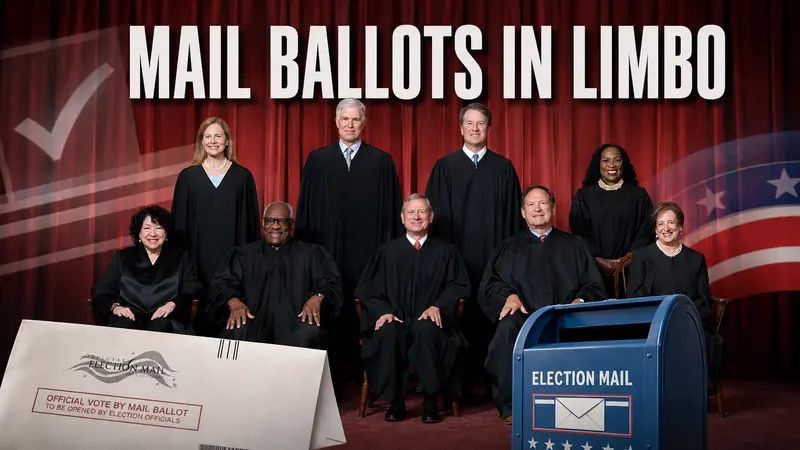
Instead, the Court temporarily removed one legal barrier preventing the Trump administration from developing new federal procedures for mail ballots before the November 3 midterm elections. The justices did not decide whether President Donald Trump’s executive order is constitutional or whether the proposed restrictions are ultimately lawful.
Trump’s March 31 order directed the Department of Homeland Security to compile state-by-state lists of confirmed adult U.S. citizens. It also instructed the Postal Service to establish new requirements for ballots sent through the mail.
The [Supreme Court’s unsigned decision](https://www.supremecourt.gov/opinions/25pdf/26a124_hgci.pdf) concluded that 23 states and the District of Columbia challenged the order too early because many implementation details were not final when their lawsuit began. The Court said states could file another challenge if a final government action caused concrete harm.
The three liberal justices dissented, warning that postponing a decision could create confusion close to the election.
Importantly, another federal court order remains in effect nationwide. That separate injunction blocks the Postal Service from enforcing the new mail-ballot requirements for the November election. The administration would have to overturn or pause that injunction before implementing the changes this year.
Therefore, as of August 24, Americans may continue voting by mail under their existing state laws.
If eventually enforced, the [Postal Service rule] (https://public-inspection.federalregister.gov/2026-17238.pdf) would require election offices to use specially marked envelopes with unique tracking barcodes and upload voters’ names, addresses and barcode information to a federal portal. The Postal Service could refuse to accept batches of outgoing ballots that fail to meet those requirements.
Individual voters would not have to register with the Postal Service. Postal carriers also would not inspect ballots or determine who is eligible to vote. Completed ballots already returned through the mail would not be subjected to the new outgoing-ballot verification process.
Older people, homebound voters and those dealing with illness or disabilities have not lost their right to request or receive absentee ballots. Eligibility and application rules still vary by state, with illness, disability or age accepted as reasons in many states. [USAGov provides links to each state’s current requirements] (https://www.usa.gov/absentee-voting).
In California, every active registered voter is still scheduled to receive a ballot beginning October 5. California voters may return it by mail, at an authorized drop box or elections office, or vote in person. Mailed ballots must be postmarked by November 3 and received by November 10. [California election officials recommend mailing ballots early] (https://www.sos.ca.gov/elections/upcoming-elections/general-election-november-3-2026).
For voters, the practical message is straightforward: mail voting remains available, but court proceedings could affect how election offices prepare and distribute ballots. Voters should verify their registration and mailing address now, follow official state instructions and return ballots as early as possible.
 Max Liebermann
 -
-
Society
US Supreme Court
absentee-voting laws
Mailed ballots
mid-term Election 2026
-
57 views -
0 Comments -
0 Likes -
0 Reviews
-
-
Society
US Supreme Court
absentee-voting laws
Mailed ballots
mid-term Election 2026
-
57 views -
0 Comments -
0 Likes -
0 Reviews





 Loading ...


