Cameras, Crime and Privacy
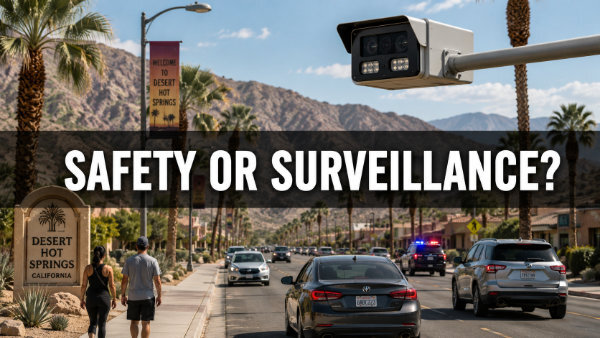
Desert Hot Springs residents are being asked to consider a difficult question: How much surveillance is acceptable when the goal is preventing crime and protecting the community?
At the center of the discussion is the city’s use of automated license-plate reader cameras supplied by Flock Safety. The cameras photograph passing vehicles and record information such as the license plate, vehicle color, make, model, location and time. The information can then be searched by authorized law-enforcement personnel investigating crimes, stolen vehicles or missing persons.
Unlike red-light cameras, the devices do not automatically issue citations. Their primary purpose is to alert officers when a vehicle associated with a police database passes a camera and to provide investigators with possible leads after a crime has occurred.
Desert Hot Springs Police Chief Steven Shaw has defended the system as an effective public-safety tool. He has said the cameras have helped officers locate stolen vehicles, find missing people and investigate crimes that might otherwise be difficult to solve. Shaw has also said the department does not share its Flock information with federal immigration authorities and limits access to legitimate law-enforcement purposes.
The public concern, however, extends beyond how police say the system is currently being used.
Flock cameras collect information from every vehicle that passes them—not only from vehicles connected to criminal activity. Privacy advocates argue that a large network of cameras can create a detailed record of where people travel, particularly when information is shared among multiple agencies.
California law requires agencies using automated license-plate readers to establish policies governing access, security, training, retention and data sharing. Searches are generally expected to be conducted by authorized personnel for legitimate purposes, with access logs available for audits.
Supporters see the technology as a practical force multiplier for a police department with limited staffing. A camera can identify a wanted vehicle at any hour and provide information far faster than officers watching traffic manually.
Critics respond that technology capable of helping solve serious crimes can also be misused, expanded or shared in ways the public never anticipated. They want clearer information about who can search the records, which agencies have access, how long information is stored and what consequences apply when a search is improper.
Both positions raise reasonable concerns.
Residents want police to have modern tools capable of addressing vehicle theft, burglary, violent crime and missing-person cases. They also have a legitimate interest in knowing how information about their daily movements is collected and protected.
The real choice may not be between cameras and no cameras. It may be between a system operating largely out of public view and one governed by clear limits, regular audits and meaningful transparency.
Desert Hot Springs residents deserve measurable information about the program’s effectiveness, including how often the cameras generate useful leads, recover stolen vehicles or contribute to arrests. They also deserve public access to the city’s policies, contract terms, data-sharing arrangements and audit results.
Public safety and personal privacy do not have to be opposing goals. But maintaining both requires more than assurances. It requires firm rules, visible oversight and continued public discussion.
 News Staff
 -
-
Arts & Culture
Desert Hot Springs
Flock Safety
automated license-plate reader cameras
-
643 views -
0 Comments -
0 Likes -
0 Reviews
-
-
Arts & Culture
Desert Hot Springs
Flock Safety
automated license-plate reader cameras
-
643 views -
0 Comments -
0 Likes -
0 Reviews






 Loading ...


