DLNews Staff
SEAL TEAM SIX STRIKES — ELITE UNIT PULLS OFF DARING IRAN RESCUE
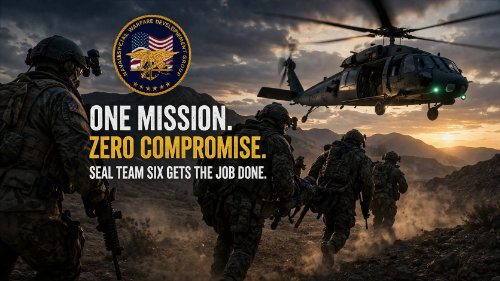
Iran—When the call came in, there was no margin for error and no time to hesitate. An American airman was alone, injured, and hunted deep inside hostile Iranian terrain. The mission to bring him home fell to the one unit built for exactly this moment—SEAL Team Six.
What followed was a masterclass in precision warfare.
After a U.S. Air Force F-15 “Strike Eagle” was shot down late Friday, its weapons systems officer survived the ejection but found himself stranded in rugged mountain terrain. For nearly 48 hours, he evaded Iranian forces, moving silently across steep ridges, hiding in crevices, and transmitting his position only under the cover of darkness.
While the airman fought to stay alive, SEAL Team Six was already moving.
The elite unit—formally known as the Naval Special Warfare Development Group—was rapidly deployed, coordinating with a vast network of U.S. military assets. Intelligence teams tracked enemy movements in real time. Surveillance systems scanned the terrain from space and air. Fighter jets and attack aircraft carved out a protective shield, striking Iranian convoys that threatened to close in.
But the heart of the mission belonged to the operators on the ground.
Under the cover of darkness, SEAL Team Six commandos advanced into one of the most dangerous environments imaginable—enemy territory, mountainous terrain, and a narrowing window before Iranian forces could intercept. Every step required discipline, silence, and absolute trust in one another.
As they closed in on the airman’s position, the team executed with surgical precision. Warning fire kept approaching forces at bay without escalating into a full firefight—an intentional move to control the situation while avoiding a broader confrontation.
Then came the extraction.
With enemy units drawing closer, the SEALs reached the mountaintop, secured the airman, and coordinated a rapid helicopter lift-out. Within moments, they were airborne—another flawless execution under extreme pressure.
Even then, the mission tested their resolve.
At a desert staging site, multiple U.S. aircraft became stuck in muddy terrain, creating a sudden and dangerous vulnerability. With Iranian forces advancing, SEAL Team Six and supporting units made the call to destroy the grounded aircraft, denying the enemy any intelligence advantage. Replacement aircraft were rushed in as the team maintained control of the perimeter.
The final evacuation unfolded under fire—but with the same discipline that defined the mission from the start. Every operator, every pilot, and the rescued airman made it out.
The injured serviceman was transported to Kuwait for medical care.
President Trump later underscored the outcome: not a single American life was lost.
For SEAL Team Six, it was another mission carried out in the shadows—no fanfare, no margin for failure, and no room for mistakes. Known globally for operations like the 2011 mission against Osama bin Laden and high-risk hostage rescues, the unit exists for moments like this.
For nearly two days, one American fought alone behind enemy lines.
Then SEAL Team Six arrived—and the mission was over.






 Loading ...


