Home After Four Lost Years
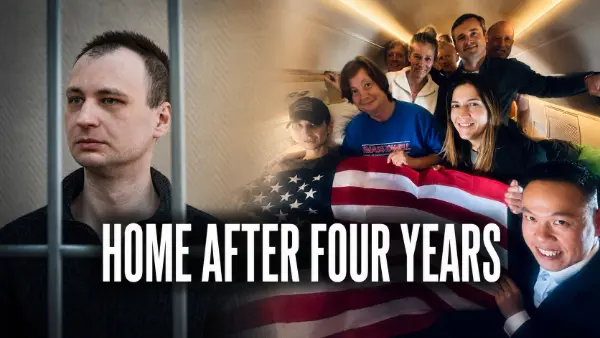
WASHINGTON — After more than four years inside Russia’s prison system, former U.S. Marine Robert Gilman is finally coming home—thin, seriously ill and carrying wounds that may take far longer to heal than the journey back to America.
Russian President Vladimir Putin granted the 32-year-old a humanitarian pardon following high-level negotiations with the Trump administration. No prisoner exchange was required, according to U.S. officials.
Gilman was flown out of Russia on Tuesday aboard a specialized medical aircraft, accompanied by four doctors. He was expected to arrive at Joint Base Andrews near Washington before traveling to a rehabilitation facility in San Antonio, Texas, for extensive medical and psychological care.
President Donald Trump said he spoke with Gilman during the flight. After years of prison food, isolation and deteriorating health, the former Marine reportedly had one simple request: a good cheeseburger.
That ordinary wish offered a brief glimpse of the person behind an international detention case—a young American hoping to reclaim the everyday life taken from him.
Gilman, a former English teacher who served in the Marine Corps from 2019 to 2020, was arrested in the Russian city of Voronezh in January 2022. He had become ill while traveling by train and was removed after allegedly causing a disturbance.
Russian authorities accused him of kicking a police officer while intoxicated. Gilman’s father disputed that account, saying his son was sick and accidentally made contact with the officer. According to the family, the officer was not injured, declined to pursue the complaint and did not present evidence at the trial.
Gilman was nevertheless convicted and initially sentenced to 3½ years. His time behind bars then became a cycle of new accusations and additional punishment. Russian courts later convicted him of attacking a prison inspector, an investigator and guards. By December 2025, his combined sentence had grown to 10 years.
Russian media reported that Gilman pleaded guilty to some of the later charges. His family and advocates, however, said the incidents occurred amid abuse, forced medication and prison conditions that appeared to generate further charges against him.
His health eventually collapsed. Global Reach, the organization representing his family, said Gilman spent 47 days in a nearly unresponsive condition that doctors described as a “dissociative stupor.” After being transferred to a civilian hospital’s psychiatric ward, he was reportedly fed through a tube while handcuffed to a bed. His mother and legal representatives were repeatedly denied access, advocates said.
Days before his release, the organization warned that Gilman could die without immediate intervention. The State Department expressed deep concern, while the White House pressed Moscow to allow him to receive treatment in the United States.
Why did bringing him home take so long?
There is no single satisfactory answer—and that is part of the tragedy.
The United States cannot simply remove an American from a foreign prison. Russia considered Gilman a convicted criminal and repeatedly added new charges, while Washington had to rely on diplomacy, consular pressure, humanitarian appeals or a negotiated exchange.
Gilman also was not publicly designated by the State Department as “wrongfully detained,” despite his family and hostage-advocacy organizations demanding that classification. Such a designation normally transfers a case to the special presidential envoy for hostage affairs and gives negotiations greater institutional priority.
At the same time, relations between Washington and Moscow had deteriorated sharply following Russia’s invasion of Ukraine. Americans released during several major exchanges were selected through difficult negotiations in which Moscow demanded specific Russian prisoners in return. Gilman was repeatedly left behind.
Ultimately, it was not a successful court appeal that freed him, but a medical emergency and direct political intervention. U.S. officials said Putin authorized the pardon after discussions with Trump, followed by intensive negotiations over the weekend. Russia requested neither a prisoner nor another publicly disclosed concession in return.
Gilman is free, but his ordeal is not over. Doctors must now determine the full physical and psychological damage caused by more than four years of imprisonment.
His return is a moment of profound relief. It is also a painful reminder that diplomacy often moves at a glacial pace while, inside a prison cell, a human life can deteriorate by the hour.
 News Staff
 -
-
Family & Home
Russia
Marine Robert Gilman
back to America
-
489 views -
0 Comments -
0 Likes -
0 Reviews
-
-
Family & Home
Russia
Marine Robert Gilman
back to America
-
489 views -
0 Comments -
0 Likes -
0 Reviews





 Loading ...


