JTFactsMax
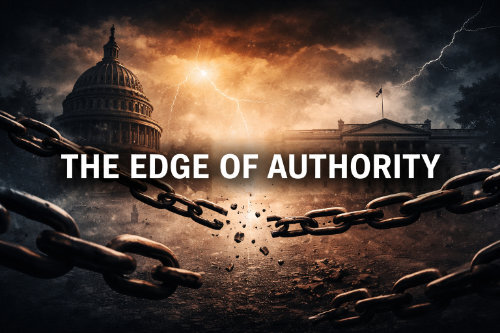
The Edge of Authority
Power in America was never designed to be absolute. Yet, every generation seems to confront the same uneasy question: what happens when a president begins to speak—and act—as if it is?
The United States Constitution is both a grant of authority and a restraint on it. It establishes a presidency that is strong enough to lead, but deliberately limited in scope. Authority is divided among three coequal branches of government, each designed to check the other. Congress writes the laws, the executive enforces them, and the judiciary interprets them. This structure is not accidental—it is the central safeguard against concentration of power in a single individual.
And yet, history shows a recurring pattern. In times of crisis, uncertainty, or political division, executive power often expands. Presidents from both parties have tested the outer boundaries of their authority, sometimes with the support of Congress, sometimes in tension with it. The balance is not fixed; it is constantly negotiated in real time.
In today’s political climate, that tension feels more visible. Statements suggesting broad or even near-absolute authority have drawn scrutiny, not because they are entirely new, but because they challenge the quiet assumptions that have long guided the office. The presidency, by design, carries immense influence—but it does not stand above the law.
Comparisons to the term “Supreme Leader” occasionally surface in public discourse, but the distinction is critical. In political systems where such a title exists, authority is often centralized, unelected, and structurally insulated from challenge. The American presidency operates in a fundamentally different framework—one that is electoral, time-limited, and subject to oversight, judicial review, and, ultimately, removal. The contrast underscores a defining principle: in the United States, sovereignty rests not in a person, but in the Constitution itself.
Still, the question remains: why does the perception of unchecked power arise again and again? Part of the answer lies in the nature of leadership. Power, once granted, has a tendency to expand unless it is actively restrained. Public trust can shift from institutions to individuals, especially in polarized times. Political messaging often elevates the idea of decisive, singular leadership—particularly during moments of national or global tension.
At the same time, the global stage amplifies every signal. When American leadership adopts a more unilateral tone, allies may interpret it as distance, even when formal relationships remain intact. In an interconnected world, perception can influence diplomacy as much as policy itself.
The Constitution, however, does not enforce itself. It depends on a system of checks and balances, but also on the willingness of leaders to operate within those boundaries—and on the public to recognize when those boundaries are being tested.
 Max Liebermann
 -
-
congress
United States Constitution
NO ONE ABOVE THE LAW
-
1K views -
0 Comments -
0 Likes -
0 Reviews
-
-
congress
United States Constitution
NO ONE ABOVE THE LAW
-
1K views -
0 Comments -
0 Likes -
0 Reviews